
Thursday, March 28, 2019

Hot Small Cap Stocks To Invest In Right Now

tags:ACHN,FCEL,MOBI,PQ,ATAI,CNR,

Small cap clinical-stage biopharmaceutical stock XBiotech Inc (NASDAQ: XBIT) has elevated short interest of 36.91% according to Highshortinterest.com. XBiotech is a fully integrated global biosciences company dedicated to pioneering the discovery, development and commercialization of therapeutic antibodies based on its True Human™ proprietary technology. XBiotech currently is advancing a robust pipeline of antibody therapies to redefine the standards of care in oncology, inflammatory conditions and infectious diseases. The Company is also leading the development of innovative biotech manufacturing technologies designed to more rapidly, cost-effectively and flexibly produce new therapies urgently needed by patients worldwide.

A technical chart for small cap XBiotech shows shares falling off heavily in early 2017 and then largely moving sideways since then:

Hot Small Cap Stocks To Invest In Right Now: Achillion Pharmaceuticals Inc.(ACHN)

Advisors' Opinion:
  • [By Logan Wallace]

    Get a free copy of the Zacks research report on Achillion Pharmaceuticals (ACHN)

    For more information about research offerings from Zacks Investment Research, visit Zacks.com

  • [By Stephan Byrd]

    Shares of Achillion Pharmaceuticals, Inc. (NASDAQ:ACHN) have earned a consensus rating of “Hold” from the six research firms that are presently covering the company, Marketbeat reports. One research analyst has rated the stock with a sell rating, four have given a hold rating and one has assigned a buy rating to the company. The average twelve-month price target among brokerages that have issued ratings on the stock in the last year is $4.50.

  • [By Logan Wallace]

    Get a free copy of the Zacks research report on Achillion Pharmaceuticals (ACHN)

    For more information about research offerings from Zacks Investment Research, visit Zacks.com

  • [By Logan Wallace]

    Get a free copy of the Zacks research report on Achillion Pharmaceuticals (ACHN)

    For more information about research offerings from Zacks Investment Research, visit Zacks.com

  • [By Stephan Byrd]

    Get a free copy of the Zacks research report on Achillion Pharmaceuticals (ACHN)

    For more information about research offerings from Zacks Investment Research, visit Zacks.com

  • [By Ethan Ryder]

    Get a free copy of the Zacks research report on Achillion Pharmaceuticals (ACHN)

    For more information about research offerings from Zacks Investment Research, visit Zacks.com

Hot Small Cap Stocks To Invest In Right Now: FuelCell Energy Inc.(FCEL)

Advisors' Opinion:
  • [By Paul Ausick]

    FuelCell Energy Inc. (NASDAQ: FCEL) posted a drop of 8.5% in short interest during the period. Some 15.18 million shares were short as of February 15, about 14.8% of the total float. The stock closed at $0.47 on Wednesday, up about 3.3% for the day, in a 52-week range of $0.43 to $2.11. Shares traded up about 19% in the first two weeks of this month, and days to cover decreased from 12 to eight.

  • [By Joseph Griffin]

    Get a free copy of the Zacks research report on FuelCell Energy (FCEL)

    For more information about research offerings from Zacks Investment Research, visit Zacks.com

  • [By Ethan Ryder]

    FuelCell Energy (NASDAQ: FCEL) and Integer (NYSE:ITGR) are both oils/energy companies, but which is the superior investment? We will contrast the two companies based on the strength of their analyst recommendations, dividends, earnings, profitability, valuation, institutional ownership and risk.

Hot Small Cap Stocks To Invest In Right Now: Sky-mobi Limited(MOBI)

Advisors' Opinion:
  • [By Logan Wallace]

    Media coverage about Sky-mobi (NASDAQ:MOBI) has trended somewhat positive this week, according to Accern Sentiment. The research group ranks the sentiment of media coverage by analyzing more than twenty million news and blog sources. Accern ranks coverage of public companies on a scale of -1 to 1, with scores nearest to one being the most favorable. Sky-mobi earned a news impact score of 0.06 on Accern’s scale. Accern also assigned news stories about the software maker an impact score of 45.6853785900783 out of 100, meaning that recent media coverage is somewhat unlikely to have an impact on the company’s share price in the near term.

  • [By Stephan Byrd]

    Mobius (CURRENCY:MOBI) traded 5.5% higher against the dollar during the 24-hour period ending at 16:00 PM E.T. on February 21st. Mobius has a market cap of $6.06 million and $37,433.00 worth of Mobius was traded on exchanges in the last 24 hours. One Mobius token can now be purchased for $0.0118 or 0.00000298 BTC on popular cryptocurrency exchanges including GOPAX, Gate.io, BitMart and Stellarport. Over the last seven days, Mobius has traded up 22.4% against the dollar.

  • [By Ethan Ryder]

    Mobius (CURRENCY:MOBI) traded 1.2% lower against the dollar during the 1-day period ending at 14:00 PM E.T. on August 21st. In the last week, Mobius has traded down 1.1% against the dollar. One Mobius token can now be bought for about $0.0291 or 0.00000452 BTC on popular cryptocurrency exchanges including GOPAX, BitMart, Gate.io and Stellar Decentralized Exchange. Mobius has a total market capitalization of $11.23 million and approximately $78,528.00 worth of Mobius was traded on exchanges in the last 24 hours.

  • [By Logan Wallace]

    Mobius (CURRENCY:MOBI) traded 12.4% lower against the US dollar during the 24 hour period ending at 17:00 PM E.T. on September 25th. One Mobius token can now be bought for approximately $0.0265 or 0.00000414 BTC on major cryptocurrency exchanges including Gate.io, Kucoin, BitMart and GOPAX. Over the last week, Mobius has traded up 8.8% against the US dollar. Mobius has a market cap of $10.22 million and approximately $69,762.00 worth of Mobius was traded on exchanges in the last day.

Hot Small Cap Stocks To Invest In Right Now: Petroquest Energy Inc(PQ)

Advisors' Opinion:
  • [By Ethan Ryder]

    News headlines about Petroquest Energy (NYSE:PQ) have been trending somewhat positive recently, Accern Sentiment Analysis reports. Accern identifies negative and positive news coverage by reviewing more than 20 million blog and news sources. Accern ranks coverage of publicly-traded companies on a scale of -1 to 1, with scores nearest to one being the most favorable. Petroquest Energy earned a coverage optimism score of 0.05 on Accern’s scale. Accern also gave news stories about the energy company an impact score of 47.638327846877 out of 100, meaning that recent news coverage is somewhat unlikely to have an impact on the company’s share price in the near future.

Hot Small Cap Stocks To Invest In Right Now: ATA Inc.(ATAI)

Advisors' Opinion:
  • [By Paul Ausick]

    ATA Inc. (NASDAQ: ATAI) traded down about 14% Monday to set a new 52-week low of $0.82, based on revalued shares that closed at $0.72 on Friday but traded up about 250% on Monday at $2.53. Volume was more than 200 times the daily average of around 42,000. You’re on your own here to figure this one out.

Hot Small Cap Stocks To Invest In Right Now: China Metro-Rural Holdings Limited(CNR)

Advisors' Opinion:
  • [By Max Byerly]

    Compass Capital Management Inc. bought a new position in Canadian National Railway (NYSE:CNI) (TSE:CNR) during the second quarter, according to its most recent 13F filing with the Securities and Exchange Commission. The fund bought 2,535 shares of the transportation company’s stock, valued at approximately $207,000.

  • [By Ethan Ryder]

    Canadian National Railway (NYSE:CNI) (TSE:CNR) has been assigned a consensus recommendation of “Hold” from the twenty brokerages that are covering the firm, Marketbeat.com reports. Twelve equities research analysts have rated the stock with a hold rating and eight have given a buy rating to the company. The average 1-year price target among brokers that have covered the stock in the last year is $93.33.

  • [By Shane Hupp]

    Shares of Canadian National Railway (NYSE:CNI) (TSE:CNR) have been assigned a consensus recommendation of “Buy” from the twenty-two ratings firms that are currently covering the firm, Marketbeat.com reports. Eleven research analysts have rated the stock with a hold recommendation and eleven have assigned a buy recommendation to the company. The average twelve-month target price among brokerages that have issued ratings on the stock in the last year is $91.71.

Monday, March 25, 2019

There's a Whole New Way to Profit in the Red-Hot Marijuana Sector

This site uses Akismet to reduce spam. Learn how your comment data is processed.

Greg MillerGreg Miller

It's hard to overstate the importance of the 2018 Farm Bill for the American cannabis business – and the folks who've had the foresight to follow along with our cannabis investing research.

As my readers have seen with the market-crushing slew of double-digit gains in our model portfolio, the Farm Bill was like flipping the switch on a money-printing machine.

But there's another, far less well-known law on the books. This is going back to 2012, although it wasn't fully implemented until 2016.

I mean the Jumpstart Our Business Startups (JOBS) Act. It was meant to encourage the funding of small businesses while easing the the burden of regulatory compliance. The Act makes it possible for a business to raise tens of millions of dollars in capital from anyone – a huge boost for most early-stage startups.

No doubt that's great news for America's economy…

… But it's an absolutely earth-shattering development for marijuana investors. It's right up there with federal legalization in terms of unleashing profit potential.

It opens to the door to a galaxy of investing opportunities in the cannabis sector.

So let me show the kinds of profits that are possible when you know how to step right through…

Join the conversation. Click here to jump to comments…

Greg MillerGreg Miller

About the Author

Browse Greg's articles | View Greg's research services

Greg Miller started working on Wall Street in September, 1987, just a month before the "Black Monday" stock market crash.

During his career there, he became an expert in just about every kind of publicly traded security - from blue-chip and small-cap stocks to municipals, junk bonds, and derivatives. As a portfolio manager, Greg was responsible for over $500 million of assets in mutual funds and insurance company accounts.

After leaving the Street, he designed a successful options trading strategy and made lucrative tech investments for a financial publication. He has also helped develop new products and worked with other editors to hone their strategies.  He's always been dedicated to deep, fundamental research - and he always will be - because he believes buying the very best companies at the right price is the best way to amass wealth in the stock market.

… Read full bio

Saturday, March 23, 2019

Buy Kalpataru Power Transmission; target of Rs 552: Sharekhan


Sharekhan's research report on Kalpataru Power Transmission


Order book strengthens (2.2x TTM) with recent order wins and order inflow visibility in railways, oil & gas provides incremental opportunities. Introduced FY2021E numbers and expect revenue and earnings CAGR of 17% and 19%, respectively, over FY2018-FY2021E.


Outlook


We maintain Buy on the stock with a revised price target of Rs. 552 on a SoTP basis, factoring in healthy execution on a strong order backlog.


For all recommendations report, click here


Disclaimer: The views and investment tips expressed by investment experts/broking houses/rating agencies on moneycontrol.com are their own, and not that of the website or its management. Moneycontrol.com advises users to check with certified experts before taking any investment decisions.

Read More First Published on Mar 20, 2019 04:20 pm
Thursday, March 21, 2019

Investors could soon get a golden opportunity to buy the precious metal, says gold ETF chief

Investors could be face-to-face with a golden opportunity, according to one fund manager.

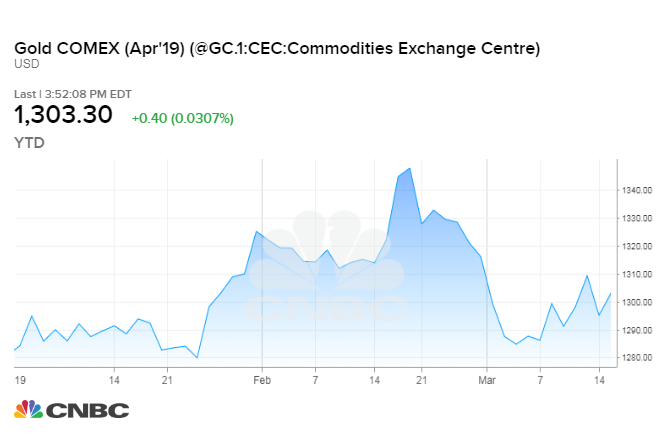
While gold prices had a strong start to the year, mounting an impressive February rally, they have erased most of those gains, now up less than 1 percent for 2019 versus the S&P 500's 12 percent rise.

But the recent losses could be pushing gold prices to buyable levels, Will Rhind, CEO of fund management company GraniteShares ETFs, said Monday on CNBC's "ETF Edge."

"You've had a bit of a V-shaped recovery in the market, but [with] gold prices selling off, this could well be a buying opportunity for gold at this point," said Rhind, whose company offers a low-fee, gold-tracking exchange-traded fund called the GraniteShares Gold Trust.

"The world is slowing down," Rhind said. "That's a weaker dollar platform in my mind, one of the key things that helps drive gold prices. So, for me, I think: Look at this price and think about defensive positioning."

Rhind suggested that investors who want to take advantage of a potential global slowdown — the likes of which typically sends gold prices soaring as market watchers look to hedge against big losses — consider funds like his, which brands itself as "The Low-Cost Gold ETF."

"For a lot of people, the fees will be the most important thing," Rhind said. "I think a lot of people will focus on that, as they rightfully should, because low fees are important. But we also added other differentiators, like holding the gold in a different location to other ETFs [and] having audit checks two times a year, for example, into the vault where we send people in and actually check the bars."

And with demand for gold picking up in places like China, where inflation is driving investors toward the historically safe yellow metal, and huge mergers by gold companies centralizing the supply, prices might not stay low for long, Rhind warned.

"Companies can't find these big new gold finds out there, so they're buying each other's capacity, and so that's why you're seeing these mega mergers going on in the space," he said. "And ... we don't have to talk about peak gold, but what we're saying is there are no major new discoveries, and therefore supply is going to be more constrained."

Gold prices are practically flat this year and down more than 3.5 percent in the last 12 months. They have been on an uptrend this month that is largely tied to a weaker dollar and ongoing uncertainty surrounding Brexit.

Disclaimer

Tuesday, March 19, 2019

The Investment Returns From Stamps - Part 2

&l;p&g;Last month began a series of three articles designed to prove that stamps were a good investment in collectibles.&a;nbsp; The analysis is based on a comparison of the stamp purchase recommendations made in my 1994 guide titled&a;nbsp; &a;ldquo;Best Buys In Postage Stamps.&a;rdquo;&a;nbsp; That book addressed over 16,000 stamps giving their appreciation histories and assigning an appreciation potential based on past results.&a;nbsp; My first article showed that mint stamps recommended in 1994 appreciated 195.5% or 7.8% per year over the 25 year from 1993 to 2018.&a;nbsp; The items not recommended appreciated 155% or 6.2% per year.&a;nbsp; These results validated two of my assumption. First it proved that stamp appreciation for stamps valued at $25 or more and issued prior to 1950 were more likely to appreciate than those issued subsequently.&a;nbsp; Secondly, it proved that analytic metrics could be applied to such stamps to find stamps that will do better than the average.&a;nbsp; What is particularly encouraging is that this took place during a time when, by all accounts, prices were assumed to have come down due to the Internet and collector demographics.&a;nbsp; We now see that this was not true for investment caliber stamps.

This article deals with the investment performance of used stamps during this same 1993 to 2018 time period. &a;nbsp;The analysis covered some 11,552 items ($29,026,877) with the following performance results:

&l;/p&g;&l;ol&g;&l;li&g;The recommended items, 4,164 now valued at $13,807,210, returned 255.5% or 10.2% per year.&l;/li&g;

&l;li&g;Of the 5242 (45.4%) items with an average return of 5% or higher each year for 25 years, the recommended totaled 1797 (43.2% of our recommendations). Contrast this with the 575 (5.0%) items with a negative rate of return of which I recommended only 179 (4.3% of our recommendations)&l;/li&g;

&l;li&g;

&l;ol&g;&l;li&g;The recommended items, 4,164 now valued at $13,807,210, returned 255.5% or 10.2% per year.&l;/li&g;

&l;/ol&g;

Their lower average return versus that for the recommended stamps is clear testimony that using financial analysis metrics on stamps does produce more positive results.&l;/li&g;

&l;li&g;The stamp universe we reviewed (11,552) broke down to annual average return percentages as follows:&l;/li&g;

&l;/ol&g;

0%&a;nbsp;&a;nbsp;&a;nbsp;&a;nbsp;&a;nbsp;&a;nbsp;&a;nbsp;&a;nbsp;&a;nbsp;&a;nbsp;&a;nbsp;&a;nbsp;&a;nbsp;&a;nbsp;&a;nbsp;&a;nbsp;&a;nbsp;&a;nbsp;&a;nbsp;&a;nbsp;&a;nbsp;&a;nbsp;&a;nbsp;&a;nbsp; &a;nbsp; 3.3%

&a;gt;0% to 2%&a;nbsp;&a;nbsp;&a;nbsp;&a;nbsp;&a;nbsp;&a;nbsp;&a;nbsp;&a;nbsp;&a;nbsp;&a;nbsp;&a;nbsp;&a;nbsp;&a;nbsp; 20.9%

2% to 5%&a;nbsp;&a;nbsp;&a;nbsp;&a;nbsp;&a;nbsp;&a;nbsp;&a;nbsp;&a;nbsp;&a;nbsp;&a;nbsp;&a;nbsp;&a;nbsp;&a;nbsp;&a;nbsp;&a;nbsp; 25.4%

5% to 10%&a;nbsp;&a;nbsp;&a;nbsp;&a;nbsp;&a;nbsp;&a;nbsp;&a;nbsp;&a;nbsp;&a;nbsp;&a;nbsp;&a;nbsp;&a;nbsp;&a;nbsp; 24.0%

10% to 20%&a;nbsp;&a;nbsp;&a;nbsp;&a;nbsp;&a;nbsp;&a;nbsp;&a;nbsp;&a;nbsp;&a;nbsp;&a;nbsp;&a;nbsp; 13.6%

20%+&a;nbsp;&a;nbsp;&a;nbsp;&a;nbsp;&a;nbsp;&a;nbsp;&a;nbsp;&a;nbsp;&a;nbsp;&a;nbsp;&a;nbsp;&a;nbsp;&a;nbsp;&a;nbsp;&a;nbsp;&a;nbsp;&a;nbsp;&a;nbsp;&a;nbsp;&a;nbsp; &a;nbsp; 7.8%

Negative % &a;nbsp;&a;nbsp;&a;nbsp;&a;nbsp;&a;nbsp;&a;nbsp;&a;nbsp;&a;nbsp;&a;nbsp;&a;nbsp;&a;nbsp; &a;nbsp;&a;nbsp;0.5%

&l;ol start=&q;5&q;&g;&l;li&g;The 5 highest appreciation stamps in the last 25 years were the following:&l;/li&g;

&l;li&g;Two Sicilies #3e went from $12 to $9,000 (74,900%)&l;/li&g;

&l;li&g;Wurttemberg #O146a went from $20 to $13,400 (66,900%)&l;/li&g;

&l;li&g;New Britain #29F went from $90 to $30,000 (33,233%)&l;/li&g;

&l;li&g;Russia #31a went from $375 to $62,500 (16,566%)&l;/li&g;

&l;li&g;Two Sicilies #5d went from $100 to $15,000 (14,900%)&l;/li&g;

&l;li&g;While used stamps outperformed mint by a significant amount, they also showed more sizable declines by certain countries. Below are the countries with the highest percentages of stamps showing declines, which may be an indication of the overall strength of that country (note the USA showed only 3.1% of issues declining):&l;/li&g;

&l;li&g;Greece &a;ndash; 13.2%&l;/li&g;

&l;li&g;Monaco &a;ndash; 27.2%&l;/li&g;

&l;li&g;Japan &a;ndash; 23.3%&l;/li&g;

&l;li&g;Belgium &a;ndash; 13.2%&l;/li&g;

&l;li&g;Germany including states &a;amp; colonies &a;ndash; 11.4%&l;/li&g;

&l;/ol&g;

The overall performance of used stamps exceeded that of mint stamps (10.2% versus 7.8% as did the aggregate value of stamps in the over $25 category ($29,026,877 for used versus $19,512,244 for mint).&a;nbsp; This reflect the fact that collecting used stamps has a much longer history than for mint ones.&a;nbsp; However, it stands to reason that mint stamps from these early years must generally be much rarer and have many more quality issues, making mint never hinged or mint with decent gum a much more difficult find.&a;nbsp; Hence, over time, it is likely that mint stamps will significantly outperform used ones.

One of the vulnerabilities for the catalog companies in the past has been their dependence on the integrity of the dealers providing them with price guidance for stamps that are not frequently traded.&a;nbsp; In addition, collectors are vulnerable to changes in the listing policies of the catalogues, which can lead to serious market mispricing.&a;nbsp; Two examples will illustrate this point.&a;nbsp; The #1 issue of St. Vincent in the 1993 Scott cataloged was priced at $8,000 mint and $500 used and continued at this level until 1998.&a;nbsp; Then in the 1999 catalog it suddenly showed no price, which continued to be the policy until 2005 when the prices suddenly appeared as $50 mint and $15 used, a whopping price decline of -93.7% and -97% respectively.&a;nbsp; The Stanley Gibbons catalogue or as they prefer, price list since they are also a dealer in such stamps, showed a similar change, however they reported the price drop as early as 1998.&a;nbsp; The reason for the change was that the stamp existed with 2 perforation varieties; an 1861 clean cut or intermediate perf 14 and 16 and an 1862 rough perf 14 and 16.&a;nbsp; I was advised by a specialist in these stamps that identification and certification of the perforations proved too difficult, so it was decided that this was a distinction without a difference and the cheaper version became the new #1.

A second example of catalogue confusion is Switzerland #195c which is assumed to be a redrawing print variety of #195 and is priced at $3,100 mint and $7,500 used.&a;nbsp; The printing variety they are pricing, however, is something entirely different and is clearly illustrated in the Zumstein Swiss catalog.&a;nbsp; At least two dealers have jumped on this discrepancy and offer this $.75 stamp on eBay; one for $500, and a second for a mere $2,925 with 24 month financing available, but with interest.&a;nbsp; To top it off, both dealers were too cheap to buy the current Scott catalogue since they show it at a previous $4,500 value versus the current $7,500.&a;nbsp; What is discouraging is that this discrepancy has existed for over two decade and no one alerted Scott.&a;nbsp; The lesson here is, when buying such high priced items, get them certified.

The Internet is a great pricing transparency guide, so I expect such occurrences will be fewer and far between.&a;nbsp;&a;nbsp; Note, however, that dependence on auction results still leaves an opening for sham sales to drive up listed prices, a practice which is hard to detect.

Note that I use the excellent Scott Classic Specialized Catalogues for much of my research and am astounded by the fact that this catalogue, which reports on all stamps issued from 1840 to 1940, has grown from 878 pages in 1995 to 1,334 in the 2019 edition, a 52% growth for a universe of stamps that has had no new issues in 79 years!&a;nbsp; The growth has been in mint never hinged listings, more forerunner (&a;lsquo;A&a;rsquo; prefix) listings, more covers being assigned numbers and in a larger type size for our ageing eyes.&a;nbsp; Also, the SCADTA and China Treaty Port issues have finally been recognized.&a;nbsp; Now if they would only recognize the Mexico provincial overprints, the Spanish civil war local issues, and telegraph stamps, life would be complete.&a;nbsp; Who says there&a;rsquo;s no growth left in stamp collecting!

Next month I will wrap up this analysis of stamps as investments with a summary of findings and conclusions which will cement the case for even the most die-hard sceptic.

Friday, March 15, 2019

Hot Value Stocks To Watch For 2019

tags:PAA,AEMD,RNR,

Magic Software Enterprises (NASDAQ:MGIC) was upgraded by BidaskClub from a “strong sell” rating to a “sell” rating in a report released on Thursday.

A number of other equities analysts have also recently weighed in on MGIC. ValuEngine cut Magic Software Enterprises from a “buy” rating to a “hold” rating in a report on Monday, May 7th. HC Wainwright set a $10.00 price target on Magic Software Enterprises and gave the stock a “buy” rating in a report on Thursday, August 9th. Bank of America cut Magic Software Enterprises from a “neutral” rating to an “underperform” rating in a report on Wednesday, June 13th. Finally, Zacks Investment Research upgraded Magic Software Enterprises from a “sell” rating to a “hold” rating in a report on Wednesday, May 16th. Two investment analysts have rated the stock with a sell rating, one has given a hold rating and three have assigned a buy rating to the stock. Magic Software Enterprises presently has an average rating of “Hold” and a consensus price target of $10.00.

Hot Value Stocks To Watch For 2019: Plains All American Pipeline L.P.(PAA)

Advisors' Opinion:
  • [By Motley Fool Transcribing]

    Plains All American Pipeline (NYSE:PAA) Q4 2018 Earnings Conference CallFeb. 5, 2019 5:00 p.m. ET

    Contents: Prepared Remarks Questions and Answers Call Participants Prepared Remarks:

    Operator

  • [By ]

    The market has pummeled master limited partnerships (MLPs) over the past few years due to the impact the oil market downturn had on their operations and business model. Among the hardest-hit have been oil pipeline MLP Plains All American Pipeline (NYSE:PAA) and gas pipeline giant Energy Transfer Partners (NYSE:ETP), both of which have lost more than half their value over the last three years. That persistent slump comes even though their turnaround strategies are beginning to gain steam. While these companies still have some work to do before they're back on solid ground, both could deliver significant returns as they complete their plans and the oil market continues rebounding over the next few years. That upside potential makes them compelling options for investors with a higher tolerance for risk.

  • [By Matthew DiLallo]

    Exxon's most recent partnership is with oil pipeline giant Plains All American Pipeline (NYSE:PAA). The companies announced this week that they're pursuing the creation of a joint venture that would build a more than 1 million BPD oil pipeline from the Permian to the Gulf Coast. That project would add to the more than $2.4 billion Plains All American plans to invest in building out Permian infrastructure over the next few years to serve the growing needs of producers in the region, which are on pace to boost oil production from 3.5 million BPD this year up to an estimated 6.4 million BPD by 2023.

  • [By Ethan Ryder]

    Plains All American Pipeline (NYSE:PAA) was upgraded by analysts at US Capital Advisors from a hold rating to an overweight rating.

    Plains GP (NYSE:PAGP) was upgraded by analysts at US Capital Advisors from a hold rating to an overweight rating.

Hot Value Stocks To Watch For 2019: Aethlon Medical, Inc.(AEMD)

Advisors' Opinion:
  • [By Max Byerly]

    Aethlon Medical (NASDAQ: AEMD) is one of 23 public companies in the “Analytical instruments” industry, but how does it contrast to its rivals? We will compare Aethlon Medical to related businesses based on the strength of its profitability, valuation, analyst recommendations, earnings, risk, dividends and institutional ownership.

  • [By Money Morning Staff Reports]

    But before we show you our pick, here are the top 10 penny stocks to watch this week…

    Penny Stocks Current Share Price (as of Jan. 5) Jan. 2-5 Gain (as of Jan. 5) My Size Inc. (Nasdaq: MYSZ) $1.66 152.28% Cytori Therapeutics Inc. (Nasdaq: CYTX) $0.47 89.52% DelMar Pharmaceuticals Inc. (Nasdaq: DMPI) $1.675 58.02% CAS Medical Systems Inc. (Nasdaq: CASM) $1.09 55.71% China HGS Real Estate Inc. (Nasdaq: HGSH) $1.83 47.58% Aethlon Medical Inc. (Nasdaq: AEMD) $1.56 43.12% Midatech Pharma Plc. (Nasdaq: MTP) $1.23 43.01% Comstock Holding Cos. Inc. (Nasdaq: CHCI) $1.87 36.5% Cenveo Inc. (Nasdaq: CVO) $1.20 31.82% EV Energy Partners LP (Nasdaq: EVEP) $0.6844 31.62%


    FREE PROFIT ALERTS: Get real-time recommendations on the best penny stock opportunities the moment we release them. Just sign up here, it's completely free…

  • [By Logan Wallace]

    Aethlon Medical (NASDAQ: AEMD) is one of 23 publicly-traded companies in the “Analytical instruments” industry, but how does it contrast to its competitors? We will compare Aethlon Medical to related businesses based on the strength of its valuation, analyst recommendations, earnings, dividends, profitability, risk and institutional ownership.

Hot Value Stocks To Watch For 2019: RenaissanceRe Holdings Ltd.(RNR)

Advisors' Opinion:
  • [By Logan Wallace]

    Kemper (NYSE: RNR) and RenaissanceRe (NYSE:RNR) are both mid-cap finance companies, but which is the better investment? We will compare the two businesses based on the strength of their dividends, valuation, profitability, earnings, risk, institutional ownership and analyst recommendations.

  • [By Logan Wallace]

    RenaissanceRe (NYSE: RNR) is one of 73 publicly-traded companies in the “Fire, marine, & casualty insurance” industry, but how does it compare to its rivals? We will compare RenaissanceRe to similar companies based on the strength of its dividends, earnings, analyst recommendations, institutional ownership, valuation, risk and profitability.

  • [By Joseph Griffin]

    Rhumbline Advisers trimmed its position in shares of RenaissanceRe Holdings Ltd. (NYSE:RNR) by 8.0% in the 2nd quarter, according to the company in its most recent Form 13F filing with the Securities and Exchange Commission. The fund owned 74,399 shares of the insurance provider’s stock after selling 6,510 shares during the period. Rhumbline Advisers owned about 0.18% of RenaissanceRe worth $8,952,000 as of its most recent SEC filing.

  • [By Logan Wallace]

    Kemper (NYSE: RNR) and RenaissanceRe (NYSE:RNR) are both mid-cap finance companies, but which is the better investment? We will compare the two businesses based on the strength of their risk, earnings, analyst recommendations, institutional ownership, profitability, valuation and dividends.

Wednesday, March 13, 2019

Analysts Anticipate Pershing Gold Corp (PGLC) to Post ($0.11) EPS

Shares of Pershing Gold Corp (NASDAQ:PGLC) have received a consensus broker rating score of 2.00 (Buy) from the two analysts that provide coverage for the company, Zacks Investment Research reports. One investment analyst has rated the stock with a hold recommendation and one has assigned a strong buy recommendation to the company.

Analysts have set a 1-year consensus price objective of $3.63 for the company and are expecting that the company will post ($0.11) earnings per share for the current quarter, according to Zacks. Zacks has also given Pershing Gold an industry rank of 46 out of 255 based on the ratings given to related companies.

Get Pershing Gold alerts:

Separately, Zacks Investment Research upgraded Pershing Gold from a “hold” rating to a “buy” rating and set a $1.25 price objective on the stock in a research report on Friday, February 15th.

In related news, major shareholder Barry C. Honig purchased 126,000 shares of the firm’s stock in a transaction that occurred on Thursday, December 20th. The shares were bought at an average price of $0.91 per share, for a total transaction of $114,660.00. The purchase was disclosed in a document filed with the Securities & Exchange Commission, which is accessible through the SEC website. 37.10% of the stock is owned by company insiders.

A hedge fund recently raised its stake in Pershing Gold stock. Renaissance Technologies LLC increased its stake in Pershing Gold Corp (NASDAQ:PGLC) by 152.5% during the third quarter, according to its most recent Form 13F filing with the SEC. The firm owned 122,186 shares of the basic materials company’s stock after purchasing an additional 73,786 shares during the period. Renaissance Technologies LLC owned approximately 0.36% of Pershing Gold worth $148,000 as of its most recent filing with the SEC. Hedge funds and other institutional investors own 21.20% of the company’s stock.

PGLC stock opened at $1.17 on Friday. The firm has a market cap of $39.40 million, a price-to-earnings ratio of -2.34 and a beta of 0.01. Pershing Gold has a fifty-two week low of $0.80 and a fifty-two week high of $2.11.

About Pershing Gold

Pershing Gold Corp. is a gold and precious metals exploration company, which engages in exploration, development and mining opportunities in Nevada. It focuses on exploration at Relief Canyon properties in Pershing County in northwestern Nevada. The company was founded on August 2, 2007 and is headquartered in Lakewood, CO.

Featured Article: Current Ratio

Get a free copy of the Zacks research report on Pershing Gold (PGLC)

For more information about research offerings from Zacks Investment Research, visit Zacks.com

Tuesday, March 12, 2019

BlackRock Inc. Grows Position in Senior Housing Properties Trust (SNH)

BlackRock Inc. increased its holdings in shares of Senior Housing Properties Trust (NASDAQ:SNH) by 2.3% during the 4th quarter, according to the company in its most recent disclosure with the Securities & Exchange Commission. The firm owned 28,383,720 shares of the real estate investment trust’s stock after acquiring an additional 634,755 shares during the quarter. BlackRock Inc. owned approximately 11.94% of Senior Housing Properties Trust worth $332,655,000 at the end of the most recent quarter.

A number of other institutional investors and hedge funds have also added to or reduced their stakes in the stock. First Trust Advisors LP boosted its position in shares of Senior Housing Properties Trust by 34.0% during the third quarter. First Trust Advisors LP now owns 658,224 shares of the real estate investment trust’s stock valued at $11,558,000 after buying an additional 167,133 shares during the last quarter. Russell Investments Group Ltd. boosted its position in shares of Senior Housing Properties Trust by 264.3% during the third quarter. Russell Investments Group Ltd. now owns 43,633 shares of the real estate investment trust’s stock valued at $765,000 after buying an additional 31,657 shares during the last quarter. Robeco Institutional Asset Management B.V. boosted its position in shares of Senior Housing Properties Trust by 42.0% during the third quarter. Robeco Institutional Asset Management B.V. now owns 1,938,131 shares of the real estate investment trust’s stock valued at $34,035,000 after buying an additional 572,782 shares during the last quarter. Daiwa Securities Group Inc. boosted its position in shares of Senior Housing Properties Trust by 10.4% during the third quarter. Daiwa Securities Group Inc. now owns 36,000 shares of the real estate investment trust’s stock valued at $632,000 after buying an additional 3,400 shares during the last quarter. Finally, American Century Companies Inc. boosted its position in shares of Senior Housing Properties Trust by 0.6% during the third quarter. American Century Companies Inc. now owns 1,368,275 shares of the real estate investment trust’s stock valued at $24,027,000 after buying an additional 8,277 shares during the last quarter. Hedge funds and other institutional investors own 71.41% of the company’s stock.

Get Senior Housing Properties Trust alerts:

SNH has been the topic of several research reports. Zacks Investment Research raised Senior Housing Properties Trust from a “strong sell” rating to a “hold” rating in a research report on Thursday, January 17th. ValuEngine cut Senior Housing Properties Trust from a “sell” rating to a “strong sell” rating in a research report on Friday, November 16th. Jefferies Financial Group cut Senior Housing Properties Trust from a “hold” rating to an “underperform” rating in a research report on Friday, November 16th. BidaskClub cut Senior Housing Properties Trust from a “hold” rating to a “sell” rating in a research report on Tuesday, November 20th. Finally, FBR & Co set a $24.00 target price on Senior Housing Properties Trust and gave the stock a “buy” rating in a research report on Thursday, December 20th. Three research analysts have rated the stock with a sell rating, one has issued a hold rating and four have assigned a buy rating to the company. Senior Housing Properties Trust has a consensus rating of “Hold” and a consensus price target of $18.20.

Shares of NASDAQ:SNH opened at $12.21 on Tuesday. The stock has a market capitalization of $2.86 billion, a price-to-earnings ratio of 8.97, a PEG ratio of 2.75 and a beta of 0.87. The company has a debt-to-equity ratio of 1.09, a quick ratio of 4.49 and a current ratio of 4.49. Senior Housing Properties Trust has a 52-week low of $11.13 and a 52-week high of $19.17.

Senior Housing Properties Trust (NASDAQ:SNH) last announced its earnings results on Friday, March 1st. The real estate investment trust reported $0.27 earnings per share (EPS) for the quarter, topping the consensus estimate of $0.16 by $0.11. The business had revenue of $285.22 million for the quarter, compared to analysts’ expectations of $287.42 million. Senior Housing Properties Trust had a return on equity of 13.42% and a net margin of 42.36%. The business’s revenue for the quarter was up 2.4% on a year-over-year basis. During the same period last year, the firm posted $0.15 earnings per share. As a group, equities analysts anticipate that Senior Housing Properties Trust will post 1.7 EPS for the current year.

The company also recently announced a quarterly dividend, which was paid on Thursday, February 21st. Shareholders of record on Monday, January 28th were given a $0.39 dividend. The ex-dividend date was Friday, January 25th. This represents a $1.56 annualized dividend and a yield of 12.78%.

ILLEGAL ACTIVITY WARNING: “BlackRock Inc. Grows Position in Senior Housing Properties Trust (SNH)” was posted by Ticker Report and is owned by of Ticker Report. If you are viewing this report on another publication, it was stolen and republished in violation of United States & international copyright and trademark laws. The correct version of this report can be viewed at https://www.tickerreport.com/banking-finance/4215060/blackrock-inc-grows-position-in-senior-housing-properties-trust-snh.html.

Senior Housing Properties Trust Company Profile

SNH is a real estate investment trust, or REIT, that owns medical office and life science properties, senior living communities and wellness centers throughout the United States. SNH is managed by the operating subsidiary of The RMR Group Inc (Nasdaq: RMR), or RMR Inc, an alternative asset management company that is headquartered in Newton, MA.

Read More: Bond

Institutional Ownership by Quarter for Senior Housing Properties Trust (NASDAQ:SNH)

Monday, March 11, 2019

Top Safest Stocks To Watch For 2019

tags:HCN,HIFR,ITHUF,IRIX,

If history is any guide, the stock market is due for a major crash soon. Nothing goes up forever, after all. There's no way to predict what the market's going to do on any given day, but we asked three of our Motley Fool contributors which stocks they think are worth buying as part of a broader capital preservation strategy.

Here's why they picked Johnson & Johnson (NYSE:JNJ), McDonald's (NYSE:MCD), and General Motors (NYSE:GM).  

Image source: Getty Images.

Built to last

George Budwell (Johnson & Johnson): If there's any publicly traded company that knows how to weather a storm, it's healthcare giant Johnson & Johnson. Incorporated in 1887, J&J has gone on to build a bonanza of world-class brands, including Band-Aid, Benadryl, Listerine, and Tylenol, among many, many others. And that's just the company's consumer healthcare segment. J&J also sports one of the most productive pharmaceutical pipelines in the world, as well as a top-notch medical device segment. The point is that J&J is an essential part of the global healthcare landscape, making it one of the safest stocks you can own.

Top Safest Stocks To Watch For 2019: Welltower Inc.(HCN)

Advisors' Opinion:
  • [By Ethan Ryder]

    Welltower Inc (NYSE:HCN), an S&P 500 company headquartered in Toledo, Ohio, is driving the transformation of health care infrastructure. The company invests with leading seniors housing operators, post-acute providers and health systems to fund the real estate infrastructure needed to scale innovative care delivery models and improve people's wellness and overall health care experience.

  • [By Shane Hupp]

    Welltower Inc (NYSE:HCN), an S&P 500 company headquartered in Toledo, Ohio, is driving the transformation of health care infrastructure. The company invests with leading seniors housing operators, post-acute providers and health systems to fund the real estate infrastructure needed to scale innovative care delivery models and improve people's wellness and overall health care experience.

Top Safest Stocks To Watch For 2019: InfraREIT, Inc.(HIFR)

Advisors' Opinion:
  • [By Joseph Griffin]

    Get a free copy of the Zacks research report on InfraREIT (HIFR)

    For more information about research offerings from Zacks Investment Research, visit Zacks.com

  • [By Joseph Griffin]

    Citadel Advisors LLC increased its position in shares of InfraREIT Inc (NYSE:HIFR) by 335.2% during the 2nd quarter, according to its most recent Form 13F filing with the Securities & Exchange Commission. The firm owned 73,755 shares of the real estate investment trust’s stock after acquiring an additional 56,809 shares during the quarter. Citadel Advisors LLC owned about 0.17% of InfraREIT worth $1,635,000 at the end of the most recent quarter.

  • [By Joseph Griffin]

    InfraREIT Inc (NYSE:HIFR) has earned a consensus recommendation of “Hold” from the six analysts that are presently covering the firm, Marketbeat reports. One analyst has rated the stock with a sell rating, four have given a hold rating and one has issued a buy rating on the company. The average 1-year price objective among analysts that have issued a report on the stock in the last year is $21.00.

  • [By Shane Hupp]

    Reaves W H & Co. Inc. trimmed its holdings in InfraREIT (NYSE:HIFR) by 18.4% in the 1st quarter, according to its most recent filing with the Securities and Exchange Commission (SEC). The firm owned 1,342,026 shares of the real estate investment trust’s stock after selling 303,392 shares during the quarter. Reaves W H & Co. Inc. owned approximately 3.05% of InfraREIT worth $26,076,000 as of its most recent SEC filing.

Top Safest Stocks To Watch For 2019: iAnthus Capital Holdings, Inc. (ITHUF)

Advisors' Opinion:
  • [By Keith Speights]

    However, there have been some winning marijuana stocks at the halfway market through 2018. Shares of MariMed (NASDAQOTH:MRMD), iAnthus Capital Holdings (NASDAQOTH:ITHUF), and Canopy Growth Corporation (NYSE:CGC) have soared. These three are the best marijuana stocks of 2018 so far for companies with current market caps of at least $200 million and that have a significant focus on the cannabis industry. 

  • [By ]

    Here is the list of the cannabis companies that we track.

    Name Currency Ticker Canopy Growth Corp. CAD (CGC) Aurora Cannabis Inc. CAD (ACBFF) Aphria Inc. CAD (APHQF) MedReleaf Corp. CAD (OTCPK:MEDFF) Cronos Group CAD (CRON) The Green Organic Dutchman CAD (OTC:TGODF) CannTrust CAD (OTC:CNTTF) Hydropothecary Corp/The CAD (HYYDF) Cannabis Wheaton Income CAD (OTCQB:CBWTF) Emerald Health Therapeutics Inc. CAD (OTCQX:EMHTF) Organigram Holdings Inc. CAD (OTCQB:OGRMF) TerrAscend Corp. CAD (OTC:TRSSF) Supreme Cannabis Co Inc./The CAD (OTCPK:SPRWF) Hiku Brands CAD (OTCPK:DJACF) ABcann Global Corp. CAD (OTCQB:ABCCF) Radient Technologies Inc. CAD (OTC:RDDTF) Village Farms International Inc. CAD (OTCQX:VFFIF) Namaste Technologies CAD (OTCQB:NXTTF) MPX Bioceutical Corp. CAD (OTCQB:MPXEF) Sunniva CAD (OTCQX:SNNVF) MYM Nutraceuticals Inc. CAD (OTCQB:MYMMF) Maricann Group Inc. CAD (OTCQB:MRRCF) Cannabix Technologies Inc. CAD (OTCPK:BLOZF) THC Biomed INTL. Ltd. CAD (OTCQB:THCBF) ICC Labs Inc. CAD (OTC:ICCLF) WeedMD Inc. CAD (OTCPK:WDDMF) CannaRoyalty Corp. CAD (OTCQX:CNNRF) InMed Pharmaceuticals Inc. CAD (OTCQX:IMLFF) Harvest One Cannabis Inc. CAD (OTC:HRVOF) Golden Leaf Holdings Inc. CAD (OTCQB:GLDFF) Benchmark Botanics Inc. CAD (OTCPK:BHHKF) Friday Night Inc. CAD (OTCQB:TGIFF) Valens Groworks Corp. CAD (OTC:MYMSF) Invictus MD CAD (IVITF) Emblem Corp. CAD (OTCPK:EMMBF) Tetra Bio-Pharma Inc. CAD (OTCQB:TBPMF) Maple Leaf Green World Inc. CAD (OTCQB:MGWFF) Delta 9 Cannabis Inc. CAD (OTC:VRNDF) Nutritional High International Inc. CAD (OTCQB:SPLIF) Lifestyle Delivery Systems Inc. CAD (OTCQX:LDSYF) Marapharm Ventures Inc. CAD (OTCQX:MRPHF) Wildflower Marijuana Inc. CAD (OTC:WLDFF) Indiva Ltd. CAD (OTC:RMKXD) Hempco Food And Fiber Inc. CAD (OTC:HMPPF) PUF Ventures Inc. CAD (OTCPK:PUFXF) Liberty Leaf Holdings CAD (OTCQB:LIBFF) Canada House Welln
  • [By Javier Hasse]

    Here are some of the top marijuana stocks in U.S. exchanges and how the performed this week:

    22nd Century Group Inc (NYSE: XXII): down 0.5 percent Aphria Inc (OTC: APHQF): down 3.6 percent Aurora Cannabis Inc (OTC: ACBFF): up 0.8 percent Cannabis Sativa Inc (OTC: CBDS): down 7.2 percent CannTrust Holdings Inc (OTC: CNTTF): down 3.4 percent Canopy Growth Corp (NYSE: CGC): down 3.9 percent Cronos Group Inc. (NASDAQ: CRON): down 3.5 percent GW Pharmaceuticals PLC- ADR (NASDAQ: GWPH): up 4.1 percent Hiku Brands Company Ltd(OTC: DJACF): down 3.1 percent India Globalization Capital, Inc. (NYSE: IGC): down 4.8 percent iAnthus Capital Holdings Inc (OTC: ITHUF): up 4.5 MassRoots Inc (OTC: MSRT): down 4 percent MedReleaf Corp(OTC: MEDFF): down 1.8 percent Scotts Miracle-Gro Co (NYSE: SMG): down 0.3 percent THC Biomed Intl Ltd (OTC: THCBF): up 9.3 percent Zynerba Pharmaceuticals Inc (NASDAQ: ZYNE): down 1.4 percent In Other News

    A consortium of cannabis-related media professionals are conducting a Cannabis Media Survey. You can answer following this link.

  • [By Keith Speights]

    Marijuana grower

    Canopy Growth Corporation (NYSE:CGC) $5.8 billion   Aurora Cannabis (NASDAQOTH: ACBFF) $2.9 billion   Tilray (NASDAQ: TLRY) $2.3 billion   Aphria (NASDAQOTH: APHQF) $1.9 billion   MedMen Enterprises (NASDAQOTH: MMNFF) $1.3 billion   Cronos Group (NASDAQ: CRON) $1 billion   The Green Organic Dutchman (NASDAQOTH: TGODF) $1 billion   The Hydropothecary (NASDAQOTH: HYYDF) $728 million   CannTrust Holdings (NASDAQOTH: CNTTF) $513 million   Organigram Holdings (NASDAQOTH: OGRMF) $509 million   Marimed (NASDAQOTH: MRMD) $472 million   TerrAscend (NASDAQOTH: TRSSF) $398 million   Auxly Cannabis (NASDAQOTH: CBWTF) $368 million   iAnthus Capital Holdings (NASDAQOTH: ITHUF) $367 million   Medical Marijuana (NASDAQOTH: MJNA) $330 million   CV Sciences (NASDAQOTH: CVSI) $299 million   Emerald Health Therapeutics (NASDAQOTH: EMHTF) $287 million   Supreme Cannabis (NASDAQOTH: SPRWF) $277 million   Smart Cannabis (NASDAQOTH: SCNA) $276 million   MPX Bioceutical (NASDAQOTH: MPXEF) $234 million   AusCann Group Holdings (NASDAQOTH: ACNNF) $223 million   Liberty Health Sciences (NASDAQOTH: LHSIF) $213 million

    Biotech

  • [By Javier Hasse]

    Licensed cannabis production facilities owner and operator iAnthus Capital Holdings Inc (OTC: ITHUF) announced a $50 million investment from Gotham Green Partners. Management believes this is the largest investment to date by a single investor in a publicly traded U.S. cannabis operating company. iAnthus plans to allocate the proceeds of this financing to repay a $20 million one-year note and accrued interest to VCP Bridge LLC; continue to build out cultivation facilities and dispensaries in the New York and Florida markets; and, potentially, to expand activities. The remaining expenditures for completing iAnthus’ Massachusetts and Vermont operations will be funded with current cash on hand, management assured.

Top Safest Stocks To Watch For 2019: IRIDEX Corporation(IRIX)

Advisors' Opinion:
  • [By Ethan Ryder]

    In related news, Chairman William M. Moore acquired 10,000 shares of the firm’s stock in a transaction that occurred on Wednesday, December 12th. The shares were bought at an average cost of $4.34 per share, for a total transaction of $43,400.00. The acquisition was disclosed in a filing with the Securities & Exchange Commission, which is available at this hyperlink. Also, Director Robert Earle Grove acquired 10,857 shares of the firm’s stock in a transaction that occurred on Wednesday, December 12th. The stock was bought at an average price of $4.23 per share, for a total transaction of $45,925.11. Following the completion of the transaction, the director now owns 2,500 shares of the company’s stock, valued at approximately $10,575. The disclosure for this purchase can be found here. Over the last three months, insiders bought 23,357 shares of company stock worth $99,750. Insiders own 4.80% of the company’s stock.

    COPYRIGHT VIOLATION NOTICE: “IRIDEX (IRIX) Set to Announce Quarterly Earnings on Tuesday” was first published by Ticker Report and is the sole property of of Ticker Report. If you are reading this article on another domain, it was illegally copied and reposted in violation of U.S. & international trademark & copyright legislation. The correct version of this article can be accessed at https://www.tickerreport.com/banking-finance/4195060/iridex-irix-set-to-announce-quarterly-earnings-on-tuesday.html.

    IRIDEX Company Profile

  • [By Max Byerly]

    First Light Asset Management LLC reduced its position in shares of IRIDEX Co. (NASDAQ:IRIX) by 48.8% during the 2nd quarter, according to the company in its most recent filing with the Securities and Exchange Commission. The institutional investor owned 198,581 shares of the medical equipment provider’s stock after selling 189,106 shares during the period. First Light Asset Management LLC owned about 1.70% of IRIDEX worth $1,382,000 at the end of the most recent reporting period.

  • [By Max Byerly]

    NxStage Medical (NASDAQ:NXTM) and IRIDEX (NASDAQ:IRIX) are both small-cap medical companies, but which is the superior business? We will contrast the two businesses based on the strength of their risk, valuation, institutional ownership, analyst recommendations, profitability, dividends and earnings.

Sunday, March 10, 2019

Thomson Horstmann & Bryant Inc. Sells 8,307 Shares of Cardiovascular Systems Inc (CSII)

Thomson Horstmann & Bryant Inc. trimmed its holdings in Cardiovascular Systems Inc (NASDAQ:CSII) by 4.4% in the fourth quarter, according to its most recent 13F filing with the Securities and Exchange Commission. The institutional investor owned 179,218 shares of the medical device company’s stock after selling 8,307 shares during the period. Thomson Horstmann & Bryant Inc. owned approximately 0.51% of Cardiovascular Systems worth $5,105,000 as of its most recent filing with the Securities and Exchange Commission.

A number of other institutional investors have also added to or reduced their stakes in the stock. Prudential Financial Inc. grew its stake in Cardiovascular Systems by 1.5% in the 4th quarter. Prudential Financial Inc. now owns 32,495 shares of the medical device company’s stock valued at $926,000 after buying an additional 471 shares in the last quarter. NJ State Employees Deferred Compensation Plan boosted its holdings in Cardiovascular Systems by 11.1% in the 4th quarter. NJ State Employees Deferred Compensation Plan now owns 10,000 shares of the medical device company’s stock valued at $285,000 after purchasing an additional 1,000 shares during the period. Quantamental Technologies LLC bought a new position in Cardiovascular Systems in the 4th quarter valued at $37,000. Diversified Trust Co boosted its holdings in Cardiovascular Systems by 16.4% in the 4th quarter. Diversified Trust Co now owns 9,950 shares of the medical device company’s stock valued at $283,000 after purchasing an additional 1,400 shares during the period. Finally, Dynamic Technology Lab Private Ltd boosted its holdings in Cardiovascular Systems by 16.1% in the 3rd quarter. Dynamic Technology Lab Private Ltd now owns 13,658 shares of the medical device company’s stock valued at $535,000 after purchasing an additional 1,896 shares during the period. Institutional investors and hedge funds own 80.59% of the company’s stock.

Get Cardiovascular Systems alerts:

Shares of NASDAQ:CSII opened at $40.26 on Friday. The company has a quick ratio of 3.88, a current ratio of 4.38 and a debt-to-equity ratio of 0.15. Cardiovascular Systems Inc has a one year low of $20.89 and a one year high of $41.13. The firm has a market capitalization of $1.40 billion, a price-to-earnings ratio of 805.20 and a beta of 2.09.

Cardiovascular Systems (NASDAQ:CSII) last announced its quarterly earnings results on Wednesday, January 30th. The medical device company reported $0.01 EPS for the quarter, beating the Thomson Reuters’ consensus estimate of ($0.04) by $0.05. Cardiovascular Systems had a net margin of 0.74% and a return on equity of 1.28%. The firm had revenue of $60.21 million during the quarter, compared to the consensus estimate of $59.66 million. On average, equities analysts expect that Cardiovascular Systems Inc will post -0.1 earnings per share for the current fiscal year.

Several brokerages have commented on CSII. BidaskClub raised shares of Cardiovascular Systems from a “buy” rating to a “strong-buy” rating in a report on Tuesday, February 5th. ValuEngine raised shares of Cardiovascular Systems from a “buy” rating to a “strong-buy” rating in a report on Tuesday. Finally, Zacks Investment Research reissued a “hold” rating on shares of Cardiovascular Systems in a report on Monday, November 12th. Two investment analysts have rated the stock with a hold rating, three have given a buy rating and two have given a strong buy rating to the company’s stock. Cardiovascular Systems has an average rating of “Buy” and a consensus target price of $47.50.

TRADEMARK VIOLATION NOTICE: “Thomson Horstmann & Bryant Inc. Sells 8,307 Shares of Cardiovascular Systems Inc (CSII)” was originally published by Ticker Report and is the sole property of of Ticker Report. If you are reading this piece on another site, it was illegally stolen and reposted in violation of international copyright and trademark law. The legal version of this piece can be viewed at https://www.tickerreport.com/banking-finance/4209865/thomson-horstmann-bryant-inc-sells-8307-shares-of-cardiovascular-systems-inc-csii.html.

Cardiovascular Systems Company Profile

Cardiovascular Systems, Inc is a medical device company, which engages in the development and commercialization of solutions for treating vascular and coronary disease. It offers orbital atherectomy systems for both peripheral and coronary commercial applications. Its products are primarily catheter-based platforms capable of treating a range of vessel sizes and plaque types.

Further Reading: Momentum Investing

Want to see what other hedge funds are holding CSII? Visit HoldingsChannel.com to get the latest 13F filings and insider trades for Cardiovascular Systems Inc (NASDAQ:CSII).

Institutional Ownership by Quarter for Cardiovascular Systems (NASDAQ:CSII)

Saturday, March 9, 2019

PNC Financial Services Group Inc. Has $2.21 Million Position in Pembina Pipeline Corp (PBA)

PNC Financial Services Group Inc. cut its holdings in Pembina Pipeline Corp (NYSE:PBA) (TSE:PPL) by 10.9% in the 4th quarter, HoldingsChannel.com reports. The institutional investor owned 74,320 shares of the pipeline company’s stock after selling 9,133 shares during the period. PNC Financial Services Group Inc.’s holdings in Pembina Pipeline were worth $2,205,000 as of its most recent filing with the Securities and Exchange Commission.

A number of other institutional investors and hedge funds have also added to or reduced their stakes in the stock. Cigna Investments Inc. New boosted its holdings in Pembina Pipeline by 7.4% in the 4th quarter. Cigna Investments Inc. New now owns 7,315 shares of the pipeline company’s stock worth $217,000 after buying an additional 506 shares during the period. Ingalls & Snyder LLC boosted its holdings in Pembina Pipeline by 1.0% in the 4th quarter. Ingalls & Snyder LLC now owns 66,423 shares of the pipeline company’s stock valued at $1,971,000 after purchasing an additional 675 shares during the period. Whittier Trust Co. of Nevada Inc. bought a new position in Pembina Pipeline in the 4th quarter valued at $33,000. Creative Planning boosted its holdings in Pembina Pipeline by 3.4% in the 4th quarter. Creative Planning now owns 45,580 shares of the pipeline company’s stock valued at $1,352,000 after purchasing an additional 1,502 shares during the period. Finally, Brasada Capital Management LP boosted its holdings in Pembina Pipeline by 61.8% in the 4th quarter. Brasada Capital Management LP now owns 4,240 shares of the pipeline company’s stock valued at $126,000 after purchasing an additional 1,620 shares during the period. 49.78% of the stock is owned by institutional investors.

Get Pembina Pipeline alerts:

PBA has been the subject of several analyst reports. Scotiabank reissued a “buy” rating on shares of Pembina Pipeline in a report on Tuesday, February 5th. Macquarie reissued a “buy” rating on shares of Pembina Pipeline in a report on Tuesday, February 5th. Credit Suisse Group raised shares of Pembina Pipeline from a “neutral” rating to an “outperform” rating in a report on Friday, November 16th. AltaCorp Capital reissued an “outperform” rating on shares of Pembina Pipeline in a report on Wednesday, February 13th. Finally, Zacks Investment Research raised shares of Pembina Pipeline from a “sell” rating to a “hold” rating in a report on Wednesday, February 13th. Two analysts have rated the stock with a hold rating and seven have issued a buy rating to the company. Pembina Pipeline currently has a consensus rating of “Buy” and a consensus price target of $40.00.

Shares of Pembina Pipeline stock opened at $36.55 on Friday. The firm has a market capitalization of $18.76 billion, a price-to-earnings ratio of 20.65, a PEG ratio of 2.96 and a beta of 0.92. Pembina Pipeline Corp has a 12-month low of $28.30 and a 12-month high of $37.19. The company has a debt-to-equity ratio of 0.61, a quick ratio of 0.51 and a current ratio of 0.70.

Pembina Pipeline (NYSE:PBA) (TSE:PPL) last announced its quarterly earnings results on Thursday, February 21st. The pipeline company reported $0.66 earnings per share (EPS) for the quarter, topping analysts’ consensus estimates of $0.48 by $0.18. The business had revenue of $1.73 billion for the quarter, compared to analyst estimates of $1.93 billion. Pembina Pipeline had a net margin of 16.90% and a return on equity of 10.93%. The company’s revenue was up .6% on a year-over-year basis. During the same quarter last year, the firm earned $0.83 EPS. Research analysts expect that Pembina Pipeline Corp will post 2.01 earnings per share for the current fiscal year.

The company also recently declared a monthly dividend, which will be paid on Monday, April 15th. Shareholders of record on Monday, March 25th will be issued a $0.1429 dividend. This represents a $1.71 dividend on an annualized basis and a yield of 4.69%. The ex-dividend date is Friday, March 22nd. Pembina Pipeline’s dividend payout ratio (DPR) is presently 94.35%.

COPYRIGHT VIOLATION WARNING: “PNC Financial Services Group Inc. Has $2.21 Million Position in Pembina Pipeline Corp (PBA)” was posted by Ticker Report and is owned by of Ticker Report. If you are reading this piece on another publication, it was copied illegally and republished in violation of United States and international copyright & trademark legislation. The legal version of this piece can be viewed at https://www.tickerreport.com/banking-finance/4208271/pnc-financial-services-group-inc-has-2-21-million-position-in-pembina-pipeline-corp-pba.html.

Pembina Pipeline Company Profile

Pembina Pipeline Corporation provides transportation and midstream services for the energy industry in North America. It operates through three divisions: Pipelines, Facilities, and Marketing & New Ventures. The company operates approximately 10,000 kilometers of pipeline network that transports hydrocarbon liquids and extends across Alberta and parts of British Columbia, Saskatchewan, and North Dakota; and owns and operates the Nipisi and Mitsue pipelines, which provide transportation for producers operating in the Pelican Lake and Peace River heavy oil regions of Alberta; transports synthetic crude oil for the Syncrude project and the Horizon project to delivery points near Edmonton, Alberta; and operates Cheecham Lateral, which transports synthetic crude to oil sands producers operating southeast of Fort McMurray, Alberta.

Read More: Understanding Stock Ratings

Want to see what other hedge funds are holding PBA? Visit HoldingsChannel.com to get the latest 13F filings and insider trades for Pembina Pipeline Corp (NYSE:PBA) (TSE:PPL).

Institutional Ownership by Quarter for Pembina Pipeline (NYSE:PBA)

Friday, March 8, 2019

Sanford C. Bernstein Analysts Give British American Tobacco Plc Ads (BATS) a GBX 3,210 Price Target

Sanford C. Bernstein set a GBX 3,210 ($41.94) price objective on British American Tobacco Plc Ads (LON:BATS) in a research note released on Monday. The brokerage currently has a neutral rating on the stock.

BATS has been the topic of several other reports. Deutsche Bank reissued a buy rating and set a GBX 4,000 ($52.27) price target on shares of British American Tobacco Plc Ads in a research note on Monday, November 26th. Cfra set a GBX 3,500 ($45.73) price target on shares of British American Tobacco Plc Ads and gave the company a buy rating in a research note on Tuesday, November 13th. Credit Suisse Group decreased their price target on shares of British American Tobacco Plc Ads from GBX 5,150 ($67.29) to GBX 4,010 ($52.40) and set an outperform rating on the stock in a research note on Tuesday, December 18th. UBS Group set a GBX 5,650 ($73.83) price target on shares of British American Tobacco Plc Ads and gave the company a buy rating in a research note on Wednesday, December 12th. Finally, Goldman Sachs Group decreased their price target on shares of British American Tobacco Plc Ads from GBX 5,350 ($69.91) to GBX 4,860 ($63.50) and set a buy rating on the stock in a research note on Monday, November 12th. One equities research analyst has rated the stock with a sell rating, five have assigned a hold rating and eleven have issued a buy rating to the stock. The company currently has an average rating of Buy and a consensus target price of GBX 3,868.67 ($50.55).

Get British American Tobacco Plc Ads alerts:

BATS opened at GBX 3,077 ($40.21) on Monday. British American Tobacco Plc Ads has a one year low of GBX 4,064 ($53.10) and a one year high of GBX 5,643.60 ($73.74).

The firm also recently disclosed a dividend, which will be paid on Wednesday, May 8th. Shareholders of record on Thursday, March 21st will be paid a GBX 50.75 ($0.66) dividend. The ex-dividend date is Thursday, March 21st. This is a boost from British American Tobacco Plc Ads’s previous dividend of $48.80. This represents a yield of 1.82%.

In other news, insider Ben Stevens purchased 689 shares of British American Tobacco Plc Ads stock in a transaction dated Tuesday, March 5th. The shares were bought at an average cost of GBX 2,883 ($37.67) per share, with a total value of £19,863.87 ($25,955.66).

About British American Tobacco Plc Ads

British American Tobacco p.l.c. provides cigarettes and other tobacco products worldwide. It manufactures vapour and tobacco heating products; oral tobacco and nicotine products, such as snus and moist snuff; cigars; and e-cigarettes. The company offers its products under the Dunhill, Kent, Lucky Strike, Pall Mall, Rothmans, Vogue, Viceroy, Kool, Peter Stuyvesant, Craven A, Benson & Hedges, John Player Gold Leaf, State Express 555, and Shuang Xi brands.

Featured Story: What is the Stochastic Momentum Index (SMI)?

Analyst Recommendations for British American Tobacco Plc Ads (LON:BATS)

Thursday, March 7, 2019

5 Best Ways To Spend Your Tax Refund

&l;p&g;&l;img class=&q;dam-image getty size-large wp-image-1131454291&q; src=&q;https://specials-images.forbesimg.com/dam/imageserve/1131454291/960x0.jpg?fit=scale&q; data-height=&q;540&q; data-width=&q;960&q;&g; Photo Credit: Getty

For many, tax time means one important thing: a tax refund.

In 2018, the average tax refund was $2,888. According to the &l;a href=&q;https://www.irs.gov/newsroom/filing-season-statistics-for-week-ending-november-23-2018&q; target=&q;_blank&q;&g;IRS&l;/a&g;, 112 million tax refunds totaling over $323 billion were issued last year.

So, how should you spend your tax refund?

Here are the 5 best ways to spend your tax refund.&l;strong&g;

&l;/strong&g;

&l;strong&g;1. Stop getting a tax refund&l;/strong&g;

What? Who doesn&s;t want a tax refund?

You don&s;t need a tax refund. It feels exciting to get one, but that tax refund is costing you money. A tax refund means you overpaid your income taxes. It&s;s called the time value of money: a dollar today is worth more than a dollar tomorrow. When you overpay your taxes, it means that you gave a free loan to the government and never got paid for it. Think of your tax refund as the government simply giving you your money back - without paying you any interest.

Make this the last year you receive your tax refund. This way, you can have that money in your pocket during each pay period to save, spend or invest. Contact your human resources department and update your tax forms to reflect your anticipated tax rate and deductions.

&l;strong&g;2. Start an emergency fund&l;/strong&g;

This is so important. An emergency can strike when you least expect it. Unemployment. An unforeseen medical expense. A surprise home repair. Please don&s;t get caught off guard.

Start an emergency fund with at least six to nine months (or more) of cash to cover expenses. Use your tax refund to start an emergency fund, or you can add to an existing one. If possible, keep this cash in a separate bank account and don&s;t touch it unless there&s;s an emergency.

&l;strong&g;3. Pay down your credit card balance&l;/strong&g;

Use your tax refund to tackle credit card debt.

You can make a one-time, lump-sum payment to pay off your credit card debt. Contact your credit card issuer to inform them to apply the payment to reduce principal. Without this instruction, your payment might be applied to your next monthly payment, which will cost your more interest.

You also could &l;a href=&q;https://www.makelemonade.co/how-to-consolidate-credit-card-debt/&q; target=&q;_blank&q;&g;consolidate your credit card debt&l;/a&g; with a personal loan that has a lower interest rate than your existing credit card interest rate.

&l;strong&g;4. Fund A Roth IRA&l;/strong&g;

What is a Roth IRA? A Roth IRA is an individual retirement account that you can fund with after-tax money. Unlike a Traditional IRA, the funds in a Roth IRA grow tax-free since they are taxed upfront.

For the 2019 tax year, if you are younger than 50 years old, you can contribute $6,000 per year. If you are 50 or older, you can contribute $7,000 per year. You can only contribute to a Roth IRA if your adjusted gross income is less than $137,000 for single filers and $203,000 for married couples (although phase outs begin for income at $122,000 and $193,000, respectively). If you withdraw any funds from your Roth IRA after age 59 1/2, they are yours to keep without paying any taxes. Also, unlike a Traditional IRA, you are not required to make mandatory withdrawals from a Roth IRA at age 70 1/2. You can open a Roth IRA with most brokerage firms. You have until Tax Day each year to fund your Roth IRA.

&l;strong&g;5. Make An Extra Student Loan Payment&l;/strong&g;

One of the best strategies to &l;a href=&q;https://www.forbes.com/sites/zackfriedman/2019/03/04/pay-off-student-loans-faster-in-2019/&q;&g;pay off student loans faster&l;/a&g; is to make an extra student loan payment. Since there are no prepayment penalties on your student loans, you can use your tax refund to make a one-time, lump-sum student loan payment.

This &l;a href=&q;https://www.makelemonade.co/calculators/lump-sum-extra-payment-calculator/&q; target=&q;_blank&q;&g;student loan calculator&l;/a&g; shows your how much money you can save when you make a one-time payment on your student loans.

Contact your student loan servicer in writing and explain that you want to make a one-time, lump sum student loan payment toward your student loan principal (not to next month&a;rsquo;s regular monthly payment).

These 5 strategies may not be your favorite ways to spend your tax refund, but they&s;re the smart path to financial freedom.&l;/p&g;

Wednesday, March 6, 2019

Colin V. Reed Purchases 6,106 Shares of Ryman Hospitality Properties Inc (RHP) Stock

Ryman Hospitality Properties Inc (NYSE:RHP) CEO Colin V. Reed purchased 6,106 shares of the business’s stock in a transaction on Monday, March 4th. The stock was bought at an average cost of $82.46 per share, for a total transaction of $503,500.76. The acquisition was disclosed in a legal filing with the SEC, which is accessible through this hyperlink.

NYSE RHP opened at $82.72 on Tuesday. The company has a debt-to-equity ratio of 4.74, a quick ratio of 1.23 and a current ratio of 1.23. Ryman Hospitality Properties Inc has a 12-month low of $64.36 and a 12-month high of $90.02. The company has a market capitalization of $4.45 billion, a PE ratio of 14.71, a price-to-earnings-growth ratio of 1.75 and a beta of 1.35.

Get Ryman Hospitality Properties alerts:

The firm also recently disclosed a quarterly dividend, which will be paid on Monday, April 15th. Stockholders of record on Friday, March 29th will be issued a $0.90 dividend. The ex-dividend date of this dividend is Thursday, March 28th. This is an increase from Ryman Hospitality Properties’s previous quarterly dividend of $0.85. This represents a $3.60 dividend on an annualized basis and a dividend yield of 4.35%.

RHP has been the topic of a number of research reports. SunTrust Banks reaffirmed a “hold” rating and issued a $76.00 price target on shares of Ryman Hospitality Properties in a research note on Thursday, November 22nd. Raymond James upgraded shares of Ryman Hospitality Properties from a “market perform” rating to an “outperform” rating in a report on Tuesday, January 8th. Zacks Investment Research downgraded shares of Ryman Hospitality Properties from a “hold” rating to a “sell” rating in a report on Wednesday, January 16th. ValuEngine upgraded shares of Ryman Hospitality Properties from a “hold” rating to a “buy” rating in a report on Wednesday, January 30th. Finally, Deutsche Bank lifted their price objective on shares of Ryman Hospitality Properties from $94.00 to $98.00 and gave the company a “buy” rating in a report on Monday, February 11th. Three equities research analysts have rated the stock with a hold rating and five have given a buy rating to the company’s stock. Ryman Hospitality Properties currently has a consensus rating of “Buy” and a consensus target price of $91.40.

Several hedge funds and other institutional investors have recently bought and sold shares of the company. Martingale Asset Management L P raised its holdings in shares of Ryman Hospitality Properties by 0.3% in the third quarter. Martingale Asset Management L P now owns 78,324 shares of the real estate investment trust’s stock valued at $6,750,000 after purchasing an additional 197 shares during the last quarter. Advisor Group Inc. raised its holdings in shares of Ryman Hospitality Properties by 18.8% in the fourth quarter. Advisor Group Inc. now owns 1,723 shares of the real estate investment trust’s stock valued at $116,000 after purchasing an additional 273 shares during the last quarter. State of Alaska Department of Revenue raised its holdings in shares of Ryman Hospitality Properties by 1.9% in the fourth quarter. State of Alaska Department of Revenue now owns 14,597 shares of the real estate investment trust’s stock valued at $972,000 after purchasing an additional 278 shares during the last quarter. Daiwa Securities Group Inc. raised its holdings in shares of Ryman Hospitality Properties by 3.8% in the fourth quarter. Daiwa Securities Group Inc. now owns 8,100 shares of the real estate investment trust’s stock valued at $540,000 after purchasing an additional 300 shares during the last quarter. Finally, Resources Investment Advisors Inc. acquired a new stake in shares of Ryman Hospitality Properties in the fourth quarter valued at approximately $25,000. Institutional investors own 87.70% of the company’s stock.

TRADEMARK VIOLATION NOTICE: This piece was first posted by Ticker Report and is owned by of Ticker Report. If you are accessing this piece on another domain, it was copied illegally and reposted in violation of US & international copyright laws. The correct version of this piece can be read at https://www.tickerreport.com/banking-finance/4197974/colin-v-reed-purchases-6106-shares-of-ryman-hospitality-properties-inc-rhp-stock.html.

About Ryman Hospitality Properties

Ryman Hospitality Properties, Inc (NYSE:RHP) is a REIT for federal income tax purposes, specializing in group-oriented, destination hotel assets in urban and resort markets. The Company's owned assets include a network of four upscale, meetings-focused resorts totaling 8,114 rooms that are managed by lodging operator Marriott International, Inc under the Gaylord Hotels brand.

Recommended Story: Asset Allocation and Your Retirement

Tuesday, March 5, 2019

Most Americans Are Missing Out on This Easy Opportunity to Grow Their Savings

It's no secret that saving money is difficult. If it weren't, we'd all be richer, wouldn't we? But the savings crisis in America has gotten so bad that the majority of working adults are dangerously vulnerable in the face of emergencies. In fact, 58% of Americans have less than $1,000 in the bank, according to a 2018 GOBankingRates survey. And a big reason for that boils down to not knowing how to effectively save.

Now you'll often hear that following a budget is a great way to keep your spending in check, and that's certainly sound advice. Similarly, boosting your income can lead to better savings, provided you're disciplined enough to sock that extra money away. But if you really want an effective strategy for saving more money, it's none other than paying yourself first with automatic transfers.

Glass jar overflowing with coins

IMAGE SOURCE: GETTY IMAGES.

Unfortunately, most Americans haven't adopted this simple, painless tactic for saving money. In fact, 69% of U.S. adults have not set up automatic transfers from a checking account to a savings account, according to GOBankingRates, even though it's one of the easiest ways to help ensure that savings goals are met.

If you've yet to set up an automatic transfer, log on to your bank's website (or pop over to a physical location, if you're so inclined) and arrange one. It could be just the trick that boosts your savings and puts you in a much more secure spot financially.

Remove the temptation to spend

Many of us have the best of intentions when it comes to saving money. We set up our budgets, cut back on non-essentials, and maybe even write up our financial goals so they stay at the forefront of our minds. But what happens when the temptation to spend out of nowhere strikes? A good 84% of Americans regularly fall victim to impulse purchases, and unless you have an extraordinary amount of willpower, you're likely to do the same.

That's why paying yourself first is so important. If you arrange for a portion of each paycheck you collect to land automatically in savings, you'll effectively remove the temptation to spend it because you won't realize that money is there. In other words, automating your savings essentially involves tricking yourself into banking extra cash -- and that's not a bad thing to do if you've historically fallen short of your savings goals.

Of course, you don't just have to send your earnings into a standard savings account. If you don't have a complete emergency fund, then your first priority should be to build one, in which case you'll want to set up money to filter automatically from checking to a savings account. But if you have a good three to six months' worth of living expenses in the bank, you can instead arrange an automatic transfer to a retirement plan and seamlessly sock away funds for the future.

If your employer offers a 401(k), the easiest thing to do is instruct your payroll department to allocate a certain percentage of your income to your retirement plan, keeping in mind that the maximum contribution for the current year is $19,000 if you're under 50, or $25,000 if you're 50 or older. Once you sign up, that money will be deducted from your paychecks so that you don't need to think about it.

If you don't have access to a 401(k) plan through work, try finding an IRA that accepts automatic transfers. This isn't a given feature for IRAs, but some accounts do let you send money over automatically. And for the current year, you can sock away up to $6,000 if you're under 50, or $7,000 if you're 50 and over.

No matter what type of account you fund initially, do yourself a favor and automate the savings process, especially if you've struggled to put money away in the past. It's one of the easiest ways to ensure that on the road to meeting your savings goals, you're not your own worst enemy.

Monday, March 4, 2019

Kratos Defense Beats on Earnings, Misses on Revenue, and Guides Both Lower and Higher

Wall Street loves a good story.

What Wall Street doesn't love, apparently, is when a story gets too confusing, with its numbers all mixed up and showing no clear direction. When a story gets as muddled as the one that Kratos Defense & Security (NASDAQ:KTOS) told last week, an investor's natural reaction may be to sell. And true to form, investors did sell off Kratos stock by nearly 3% on Friday.

Was that a mistake?

Drone firing rockets at a tank

Kratos shoots but doesn't score on either profits or free cash flow in 2018. Image source: Getty Images.

What Kratos said

To get an idea for just how much confusion Kratos caused investors last week, let's take a quick look at the company's Q4 earnings report, released after the close of trading on Thursday.

Quarterly revenue declined 1% to $164.4 million, with service revenue growing -- but not enough to offset declines in product sales. Gross profit declined as well. However, freed from a large charge to earnings for goodwill impairment that weighed down Q4 2017 results, operating profit turned positive in Q4 2018, coming in at $10.8 million, and Kratos reported a $4.7 million net profit for the quarter, or $0.04 per diluted share.

Thus, despite reporting sales 13% shy of Wall Street analyst estimates, Kratos reported profit greater than what analysts had forecast.

So far, so good.

Good news, bad views

Where things went wrong for Kratos was on guidance, with management forecasting that in Q1 2019 it will book revenue of only $147 million to $157 million. Assuming this is how things do, in fact, play out, those amounts would fall about 11% short of Wall Street's estimates for Q1 -- and it would mean Kratos will miss on sales for a second straight quarter. For a company that can't point to profits as a reason to own it, as it remains unprofitable, that's worrisome news.

That Kratos is promising to make up the difference later in the year, and book revenue of between $720 million and $760 million -- at the midpoint, 2% more revenue than Wall Street projects -- doesn't seem to have allayed investor concerns about the company's near-term performance.

Close, but no cigar

Yet consider that for fiscal 2018, Kratos came very close to reporting full-year profitability, cutting its net loss from $42.7 million a year ago to just $3.5 million in 2018. Free cash flow, a disheartening negative-$53 million in 2017, came within a whisker of fulfilling management's promise to deliver positive free cash flow in 2018. Operating free cash flow was $18.1 million. Minus $22.6 million in capital spending, free cash flow for 2018 was negative-$4.5 million.

There are of course two ways to view these numbers. On one hand, Kratos came very close to keeping its promise to earn a profit and generate free cash flow in 2018. On the other hand, "close" wasn't enough to win Kratos a cigar.

What comes next

Can Kratos do for investors what it promised but failed to do in 2018? Revenue, while not entirely as robust as Wall Street would like to have seen, do look primed to grow in the new year, with Q4 new backlog surging 19% in 2018, and Q4 bookings exceeding revenue by 30%, for a book-to-bill ratio of 1.3.

Furthermore, Kratos' unmanned aerial vehicles division is growing great guns, with sales up "approximately 75% over the past 24 months," and management promising "90% organic growth" in target drones in particular in 2019. Kratos' combat drone initiative, which the company calls its "tactical drone" program, now has six active development projects under way, "with several additional programs expected to be under contract by the end of" 2019.

With momentum on Kratos' side, I don't think it's unreasonable to believe that the company can follow through on its commitment to deliver $740 million in sales (plus or minus) in 2019. And if it does produce these sales, that would work out to 20% growth.

Most analysts at this point agree that 2019 will be the year Kratos finally returns to GAAP profitability and produces its first free cash flow-positive year since 2013, setting the stage for ever-higher earnings and free cash flow in the years to come. Whether this makes Kratos a bargain at $1.7 billion in market capitalization -- nearly 3 times sales -- remains to be seen.

Sunday, March 3, 2019

Walker & Dunlop Inc (WD) Files 10-K for the Fiscal Year Ended on December 31, 2018

Walker & Dunlop Inc (NYSE:WD) files its latest 10-K with SEC for the fiscal year ended on December 31, 2018. Walker & Dunlop Inc is a provider of commercial real estate finance, with a primary focus on multifamily lending. The Company originates, sells, and service a range of multifamily and other commercial real estate finance products. Walker & Dunlop Inc has a market cap of $1.73 billion; its shares were traded at around $55.49 with a P/E ratio of 10.97 and P/S ratio of 2.62. The dividend yield of Walker & Dunlop Inc stocks is 1.89%. Walker & Dunlop Inc had annual average EBITDA growth of 25.20% over the past five years.

For the last quarter Walker & Dunlop Inc reported a revenue of $214.9 million, compared with the revenue of $238.6 million during the same period a year ago. For the latest fiscal year the company reported a revenue of $725.2 million, an increase of 1.9% from last year. For the last five years Walker & Dunlop Inc had an average revenue growth rate of 19.9% a year.

The reported diluted earnings per share was $5.04 for the year, a decline of 23.2% from the previous year. Over the last five years Walker & Dunlop Inc had an EPS growth rate of 39.8% a year. The Walker & Dunlop Inc had a decent operating margin of 30.75%, compared with the operating margin of 35.08% a year before. The 10-year historical median operating margin of Walker & Dunlop Inc is 34.01%. The profitability rank of the company is 8 (out of 10).

At the end of the fiscal year, Walker & Dunlop Inc has the cash and cash equivalents of $90.1 million, compared with $191.2 million in the previous year. The long term debt was $1.5 billion, compared with $1.1 billion in the previous year. The interest coverage to the debt is at a comfortable level of 22. Walker & Dunlop Inc has a financial strength rank of 4 (out of 10).

At the current stock price of $55.49, Walker & Dunlop Inc is traded at 50.2% premium to its historical median P/S valuation band of $36.95. The P/S ratio of the stock is 2.62, while the historical median P/S ratio is 1.76. The stock gained 17.63% during the past 12 months.

Directors and Officers Recent Trades:

President Howard W Smith Iii sold 62,004 shares of WD stock on 02/06/2019 at the average price of $50.58. The price of the stock has increased by 9.71% since.

For the complete 20-year historical financial data of WD, click here.

Saturday, March 2, 2019

PGT Inc (PGTI) Q4 2018 Earnings Conference Call Transcript

Logo of jester cap with thought bubble.

Image source The Motley Fool.

PGT Inc  (NYSE:PGTI)Q4 2018 Earnings Conference CallFeb. 27, 2019, 10:30 a.m. ET

Contents: Prepared Remarks Questions and Answers Call Participants Prepared Remarks:

Operator

Good day, everyone, and welcome to the PGT Innovations Fourth Quarter 2018 Earnings Call. Today's conference is being recorded. After today's presentation, there will be an opportunity to ask questions. (Operator Instructions) I'd now like to turn the conference over to Brad West. Please go ahead.

Brad West -- Senior Vice President and Chief Financial Officer

Good morning, and welcome to the PGT Innovations Fourth Quarter 2018 Earnings Conference Call. All participants will be in a listen-only mode. And good morning and thank you for joining us on our call today. This morning, we are pleased to provide our fourth quarter and fiscal year 2018 results, as well as an outlook for 2019. In addition to the news release, we have provided a slide presentation to accompany today's discussion. This webcast is being recorded and will be available for replay on the Investors page on our website at pgtinnovation.com along with the supporting slides.

Before we begin, please direct your attention to the disclosure statements on Slide 2 of the presentation, as well as the disclaimers included in the press release related to forward-looking statements. Today's remarks contain forward-looking statements including the outlook for our 2019 performance that involve risks, uncertainties and other factors that could cause actual results to differ materially. This disclaimer is a brief summary of the Company's statutory forward-looking statements disclaimer, which is included in the Company's filings with the SEC.

Additionally, on Slide 3, you should also note that we report results using non-GAAP measures, which we believe provide additional information for investors to help facilitate comparison of past and present performance. A reconciliation into the most directly comparable GAAP measures is included in the tables attached to the earnings release and in the appendix of the slides presentation.

I would now like to turn the call over to Jeff Jackson, PGT Innovation's CEO and President.

Jeffrey T. Jackson -- Chief Executive Officer and President

Thanks, Brad, and good morning, everyone. Fiscal year 2018 was a transformative year for PGT Innovations, and I'm very pleased with our results. On Slide 4, we have included some background information on our Company for those of you who may be new to the story. And I will highlight some key facts.

Our full year sales of $698 million represent a 37% increase over 2017, with 27% of our year-over-year growth achieved organically. With the acquisition of Western Window Systems last year, we became a national leader in the premium window and door space. The acquisition expanded our geographic footprint and rebalanced our portfolio to nearly 50-50 split between repair and remodeling and new construction in markets. Additionally, Western has a strong non-impact brand that come in at higher margins as with our legacy impact products.

To finance the acquisition, we entered the bond market for the first time, and as a result, over 80% of our current leverage is at an attractive fixed rate of 6.75%. Following the acquisition, we've completed a successful equity offering with net proceeds used to pay down our debt, floating rate debt, quickly deleveraging our balance sheet. I'm proud to report PGT Innovations net leverage in the 2018 was 2.1 times. We believe this balance sheet provides significant strength and flexibility for future operational and strategic initiatives.

Turning to Slide 5, it's important to take a few minutes to review our strategy for creating long-term value for our customers and shareholders. At PGT Innovations, we attribute our success to the continued execution of our four strategic pillars. Our first pillar is putting the customer at the center of our business, striving to deliver 360 degree service before, during and after the sale.

Second, we worked hard to attract top talent and we offer benefits and support to help our team member succeed. We believe that a talented, dedicated team of employees is key to success and we continually look for ways to make our Company an attractive place to have a career. In 2018, I am especially proud we made every employee a shareholder, giving them a chance to participate in our future success. We continue this benefit from another grant through all our team members at the beginning of 2019.

Third, we are committed to investing in our business when it is prudent to do so and scaling operations to meet increasing demands. Our organic growth of 27% in 2018 with solid margin improvement pretty much with significant accomplishments that would not have been possible without well-time strategic investments in our business to increase production capacity and improve efficiencies. Looking forward, we expect to continue to invest in operational projects designed to improve efficiency and capacity.

And fourth, we strategically allocate capital generated from our strong free cash flow to reduce our debt and support our growth. Going forward, we expect to maintain a strong balance sheet and build cash to allow flexibility for futuristic and opportunistic acquisitions and other investments in our business. We anticipate that our strategic path forward will involve creating a national market-leading building products company with a team focused on niche products and brands, which will continue to yield strong margins and significant cash flow.

Now, I'd like to discuss our results in more detail. Beginning on Slide 6, I'm excited to report another quarter of strong financial results reflecting continued growth in demand for our impact-resistant products in our legacy markets and growth in demand for our Western Window Systems' energy-efficient products, which are designed to unify indoor-outdoor living space.

For the quarter, we delivered sales of $190 million including a sales contribution of $31 million from Western Window Systems acquisition and organic growth of $24.7 million or 18%. Our legacy repair and remodeling and new construction markets grew by approximately 18% and 19% respectively versus the prior-year quarter. Adjusted gross margin grew by 2.3% in the fourth quarter versus prior year, due largely driven by the accretion from the Western Window Systems acquisition. Our legacy markets, we were successful in implementing price increases and driving operational efficiencies to offset labor, material and other cost inflations in our business. Adjusted EBITDA of $31.5 million in the fourth quarter represents growth of 34% versus the same quarter last year.

On Slide 7, for our full year, I'll reiterate the 2018 sales increased by 37% to $698 million, which includes the sales contribution of $49.7 million from Western Window Systems, versus the prior year, sales in our legacy repair and remodeling and new construction markets grew by approximately 34% and 17%, respectively.

Adjusted gross margin for 2018 grew by 1.3% versus 2017 driven primarily by our successful efforts in implementing price increases and driving operational efficiencies, including a significant reduction in our scrap. Gross margins were also positively impacted by the accretion from our Western Window Systems acquisition. Adjusted EBITDA for the year of $127 million, an increase of 48% versus prior year.

Next, turning to Slide 8. I would like to provide a further update on Western Window Systems. After closing on the acquisition in August of last year, integration is on schedule and well under way. We expect first year annualized cost synergies of approximately $8 million primarily coming from supply chain efficiencies where we can offer greater economies of scale. We also anticipate many cross-selling opportunities and strengthen brand recognition as we utilize brands across the PGT Innovations portfolio. The Western Window Systems acquisition meaningfully expanded our geographic coverage and enhanced our premium product offering in the growing indoor-outdoor living market and created synergy opportunities moving forward.

Moving to Slide 9, I would like to remind you we are currently four years into our strategy to become a national leader of premium windows and doors. The phase one was to further solidify our position in our core market of Florida by increasing our product offerings to meet the needs of our customers in our market. Next, we acquired CGI and WinDor, the second and third strongest brands in the impact product space in 2014 and '16, respectively. We were able to complete these acquisitions and subsequent integrations while maintaining industry-leading margin profiles. The next phase of our strategy is and continues to be expansion into new geographies and other niche window and door products. We took our first step by the addition of Western Window Systems in this product lines, which satisfy some of the most stringent energy codes and regulations in North America, and serve a growing contemporary indoor-outdoor living segment across the country. We believe the Western Window Systems will continue to achieve sales growth above the overall market by adding builders who desire the products Western owns, and that will continue to achieve industry-leading margins by focusing on high-end niche, energy-efficient windows and doors while driving continuous operational improvements.

Turning to Slide 10, while certain regions of the national housing market has shown signs of slowing, we expect Florida to maintain its position as the fastest growing state in the nation. With a population of more than 21 million, we continue to believe there is significant new construction growth potential remaining. In Florida, we are estimating the 2019 housing starts to be approximately 105,000, well below the normalized single family starts of approximately 125,000 per year.

On Slide 11, prior to 2018, it was estimated that of the homes in Florida, only 18% have impact-resistant windows, 13% have impact-resistant doors and 18% storm shutters. That indicate that at least 50% of Floridians have no protection on their openings of their homes to safeguard their property against severe storms prior to 2018. This 34% growth we experienced in the repair and remodeling market in 2018 is evidence that many Floridians decided to add impact-resistant windows and doors and new shutters and plywood. Hurricane Michael and Irma demonstrated that every home in Florida, not just total homes, can be impacted by severe weather. As a result, homeowners throughout the entire state have become searching for Hurricane protection for their homes, which is why we believe our advertising and marketing investments continue to benefit our growth.

With Western Window Systems, we have expanded into the indoor-outdoor living market, which represents a total opportunity of approximately $8 million to $9 million. The largest segment is in new construction of high-end homes that feature more back-line doors in the back of the houses. From 2012 to 2017, the indoor-outdoor living market saw an average annual growth rate of 11%. For new contemporary homes, this market represents approximately $2 billion opportunity and is growing at a faster pace averaging 24% per year from 2012 to 2017.

Now, I'd like to turn the call over to Brad to discuss the financial results in more detail. Brad?

Brad West -- Senior Vice President and Chief Financial Officer

Thank you, Jeff. First, I would like to review some of our significant achievements in 2018 and then discuss fourth quarter results in more detail. In August 2018, we acquired Western Window Systems for $355 million. In order to finance the transaction, we entered the bond markets for the first time raising $350 million at attractive rate of 6.75%. At the consummation of the acquisition, our gross leverage ratio was approximately 4 times trailing 12 months adjusted EBITDA inclusive of $8 million in annual cost synergies, and within our targeted range of 2 times to 4 times.

In September 2018, we completed a stock offering, which generated proceeds allowing us to pay down $152 million of our current loan credit facility to further strengthen our balance sheet. In the fourth quarter, we also paid an additional $8 million of our current loan credit facility. As Jeff mentioned, at the end of fourth quarter, our net leverage ratio has improved to 2.1 times and over 80% of our remaining leverage is at fixed rate of 6.75% in an environment of rising interest rates.

Another positive result of our $152 million debt pay-down was that we received ratings upgrade from Moody's to B1. Additionally, we have a B Plus rating from Standard & Poor's with a positive outlook. We believe our access to long-term borrowings at an attractive rate together with the completion of an acquisition that provides us with geographical and product line diversity and other benefits has put PGT Innovations in a strong financial and operational position, well poised for continued growth.

Now moving on to Slide 12 for a summary of our results for the quarter. We reported net sales of $189.9 million, including our organic growth of $24.7 million or 18%, driven by a growth in our legacy repair and remodel and new construction markets of 18% and 19%, respectively versus prior year. Fourth quarter sales also included a sales contribution of (inaudible) from Western Window Systems.

Our gross profit exclusive of adjusted items was $66.1 million for the fourth quarter of 2018, up $22.6 million versus the fourth quarter of 2017, and adjusted gross margin increased to 34.8% or 2.3% increase from prior year, driven mainly by gross margin accretion from Western Window Systems in our fourth quarter.

In our legacy business, we were able to offset higher cost with increases in our prices, higher volumes and improved operating effectiveness and efficiency. You get an update on our aluminum covered program, the increase in aluminum prices had a negative impact of 1.5 percentage points on the gross margins in the fourth quarter. As of today, we have contracted approximately 75% of our estimated aluminum needs for 2019. Our current coverage for aluminum portion only in is at $0.96 per pound. This does not include the delivery cost which today is approximately $0.19 per pound. We will continue to monitor tariff and trade environment effects on aluminum pricing and as appropriate make adjustments for our covered program and pricing strategy.

Selling, general and administrative expenses were $45.6 million in the fourth quarter 2018, an increase of $19.2 million from $26.4 million in the fourth quarter '17. Adjusted selling, general and administrative expenses was $44.1 million in the fourth quarter or 23% of net sales compared to $25.6 million in the fourth quarter of 2017 or 19.1% of sales, an increase of 4.1%.

Western Window Systems contributed $12.6 million including $2.4 million of non-cash amortization and SG&A in the fourth quarter of 2018. Our legacy business SG&A grew from 19.1% of sales in the fourth quarter of '17 to 19.8% of sales in the fourth quarter of '18, including $1.7 million of higher incentive compensation due to our improved performance year-over-year.

Adjusted EBITDA in the fourth quarter of 2018 was $31.5 million or a margin of 16.6% compared with adjusted EBITDA of fourth quarter '17 of $23.5 million or 17.5%. As additional information, the new accounting standard for revenue recognition impacted our fourth quarter 2018 results negatively by reducing sales and adjusted EBITDA by $7.5 million and $2.5 million, respectively, which reduced our adjusted EBITDA margin by 70 basis points.

Interest expense for the fourth quarter was $7.1 million, an increase of $1.8 million versus last year. The increase in interest expense was primarily due to a higher debt balance for the quarter. The current quarter interest expense includes approximately $300,000 of non-cash charges related to the $8 million prepayment that we made during the quarter.

Depreciation and amortization expense was $8.6 million in the fourth quarter 2018, an increase of $3.4 million versus the prior-year period, driven mainly by the acquisition of Western Window Systems. Taxes for the fourth quarter were $2.5 million at an effective tax rate of 19.4%. Additionally, in the fourth quarter of 2017, we had a tax credit of $12.4 million reflecting the positive impacts of the Tax Cuts and Jobs Act. Tax expense in the fourth quarter of 2018 was favorably impacted of $6,500 for excess tax benefits of stock option exercises.

We reported GAAP net income of $10.9 million or $0.18 per diluted share for the fourth quarter versus $20.3 million or $0.39 per share in the fourth quarter of 2017. Excluding one-time items, adjusted earnings per share for the fourth quarter of 2018 was $0.21 versus $0.18 in the same quarter last year, representing a 17% increase.

Moving on to Slide 13, I would like to review our current expectations regarding our capital allocation priorities. Our first priority is internal investment and strategic growth projects that we believe are important to PGT Innovations' ability to drive future shareholder value, and we expect to continue to support our product portfolio by making investments in advertising and marketing, which have proven beneficial to our growth. Our second priority is at reductions in making an solid balance sheet. I've already gone over how we completed a major transaction and we are able to subsequently paid down debt to finish the year with a net debt to EBITDA ratio of 2.1 times. We maintain as a goal, achieving a conservative leverage profile within the range of 2 times to 4 times.

Our third priority for capital allocation is not -- just looking for strategic acquisitions. We expect to continue to look for attractive opportunities to expand into new geographies and/or other niche window and door products.

Looking ahead to 2019, on Slide 14, I'll give some of our expectations regarding combined company assumptions going forward. We expect interest expense the approximately $7 million per quarter. We expect the tax rate around 26%. We expect depreciation and amortization expense to be approximately $9 million per quarter. And we expect annual non-cash stock compensation to be approximately $4.2 million due to our employee stock base (ph), Lastly, we expect capital expenditures to be -- to average between 3% and 4% of annual sales.

And finally, I would like to review 2019 guidance provided this morning. PGT Innovations expects to finish in the following ranges for 2019 fiscal year: net sales of $775 million to $800 million, an increase of 11% to 15% compared to 2018; adjusted EBITDA of $143 million to $152 million, an increase of 13% to 20% compared to 2018; and net income per diluted share of $0.93 to $1.05. In first quarter, we are currently tracking to $174 million to $179 million in sales, which will be growth of approximately 3% to 5% on a pro forma basis. This is higher than our full year guidance of 3% at the top end of our annual range. EBITDA for Q1 is expected to finish at approximately 16% (inaudible).

With that, I'd like to turn the call back over to Jeff for some closing thoughts. Jeff?

Jeffrey T. Jackson -- Chief Executive Officer and President

Thank you, Brad. Now, I'd like to take a few minutes just to elaborate on the macro economic assumptions behind our guidance for 2019. Consistent with many industry forecasters, we are expecting a low single-digit growth rate in national housing starts, mainly due to labor constraints, affordability concerns and interest rate increases we experienced in 2018. Relating to a couple of our core markets, we are expecting new home starts in Florida to grow approximately 9% to 10% in 2019. While we expect new home starts in California to remain relatively flat versus -- in 2019. We believe PGT Innovations is strategically insulated in most building product companies from national housing starts. Due to our geographic concentration in destination states and our focus on selling into indoor-outdoor living market, which has historically grown at rates higher than the national housing starts.

Regarding the growth prospects for the indoor-outdoor living market, please note that Western Window Systems has grown at a compound annual growth rate of approximately 22% since 2015, far exceeding the growth than housing start during that period. We believe this level of growth demonstrates the strength of demand for building products that unify indoor-outdoor living spaces and we anticipate opportunity to continue to gain market share and penetrate into this growing market. Our 2019 guidance assumes an overall high single-digit growth rate for new construction sales.

Related to the repair and remodeling market, we just concluded the strongest year in Company history, with 34% repair and remodeling growth fueled by Hurricane awareness from Irma, the first hurricane hit Florida since 2005. While we believe repair and remodeling markets are still strong quarter, our expectations will be for the repair and remodeling market to be flat as 2018 with another storm driving further awareness. Regardless, at the end of 2019, our two-year compound annual growth rate will still be quite healthy. Florida remains in great state to operate in and we will continue to drive sales of our impact-resistant products with our leading market position, of highly innovative product offerings and increase adversiting.

From a margin perspective, our 2019 guidance assumes the following: cost inflation from materials mainly due to tariffs; continued wage inflation associated with attracting and retaining qualified workers; the negative impact of mix that will result from new construction sales outpacing the repair and remodeling growth, somewhat offset by the impact of a price increase announced in the back half of 2018. We will strive to continue to drive operational efficiencies as we demonstrated during 2018, and supply chain initiatives also to offset these cost of inflation initiatives. Finally, our guidance for 2019 assumes that there are no major hurricanes in Florida that would disrupt our ability to manufacture and deliver our products or disrupt the ability of our dealers to take orders during 2019.

In closing, I'd like to remind you of the five elements of our investment thesis; first -- on Slide 15, first, we are national leader in the growing category of premium window and doors. Second, we are committed to continuing our investments in talent and R&D to remain the industry leader with innovative products. Third, we have an ongoing focus on operational efficiency expected to drive additional margin expansion. Four, we are focused on striving to achieve strong execution of our strategy to create long-term customer and long-term shareholder value. And fifth, we are well positioned with a diversified product portfolio and a diversified geographic markets to capture profitable growth in new construction and repair and remodeling trends. 2018 was a milestone year for PGT Innovations and our team. It is an exciting time to be a part of our family of brands.

At this time, I'd like to turn the call over to the operator to begin our Q&A. Operator?

Questions and Answers:

Operator

Thank you. We will now begin the question-and-answer session. (Operator Instructions) We'll take our first question from Truman Patterson with Wells Fargo.

Truman Patterson -- Wells Fargo -- Analyst

Hi, good morning guys. Thanks for taking my questions. The first one -- first thing that I'd like to dig into is your revenue growth guidance for 2019, you guys set up 11% to 15%. If I throw in an extra seven to eight months of Western Windows in there, it seems like your guidance implies flat to maybe 1% growth in the legacy PGTI and even Western Windows growth in there. Could you walk us through the moving parts, you guys said California market should be flat while Florida new resi (ph) should be up high single digits. I think this implies that actually Florida R&R should be negative then. Could you just walk us through how to think about this?

Jeffrey T. Jackson -- Chief Executive Officer and President

Yes. I'll touch on that and I'll let Brad dig in some details as well. As Brad told -- mentioned in his comments, our Q1 guidance, right now, Florida overall company, we are tracking anywhere from 3% to 5% growth in our first quarter, that's before our heavy R&R quarters. And the second and third quarter are very heavy R&R periods for PGT legacy brands and we are comping an incredible year, 34% growth rate in R&R, largest percentage in our Company's history, largest base in our Company's history. So, right now, we have that kind of headwinds that to go through and we're trying to lay out what we consider a conservative guidance as we face that comp that will impact us on that process. Second is moving to California market, which you mentioned in your comments that the California market being flat; what we have to do and it will be new for us this year consistent with Western previous but we have to execute in that flat market and gain share.

We think we want to -- we got initiatives to drive penetration in a flat market, we think we can still grow, but our assumption in our guidance is that's flat and that's going to be a tough hurdle to overcome. So those are the two driving initiatives that have our guidance to where it is and we have initiatives in place to address at all, it's just too early in the process for us to be aggressive and thinking we going to succeed.

Brad West -- Senior Vice President and Chief Financial Officer

And let me add to that -- as going to last year, in Q4 of '17, you started to see in the demand for R&R pickup and that carried all the way through 2018 as we mentioned. But at the beginning of the year, we kind of anticipated some of that -- a price increase that we announced at the beginning of last year and also the middle of the summer season, we announced a price increase specifically dealing with aluminum heritage rate that was going on. We had two price increases last year as well that also probably drove some of the summer season tough comps that we are dealing with as we go into 2019.

Truman Patterson -- Wells Fargo -- Analyst

I'm having a little bit of a hard time hearing you guys. But is it safe to assume that what's implied in your guidance is probably negative R&R growth yet that might not be exactly what's in your real expectations, is that safe to assume?

Brad West -- Senior Vice President and Chief Financial Officer

Yes. Again, we're comping at 34% incredible growth year, and so, yes, we are saying, after an another major storm or something happening, we could be negative to slightly negative in our R&R growth offset by obviously new construction still growing that's taking share there and then offset somewhat again by tough comp in California with housing starts -- everyone saying they're going to be roughly flat and trying to gain penetration there.

Truman Patterson -- Wells Fargo -- Analyst

Okay. Okay, thanks. Thanks for that guys. Another question on guidance. When we look at your 2019 EBITDA margin, the midpoint I think is only up about 50 bps year-over-year at 18.7% or so. It seems like the accretion from Western alone just from another seven to eight months should add that to your 2019 margins alone. This is excluding any of the $8 million in synergies that you guys are suggesting you're going to achieve. So, essentially we've got flat legacy PGTI and flat Western Windows margins year-over-year. I guess what's driving that or are there any mix issues, are we actually going to see negative gross margins or just flat gross margins, flat SG&A? I'm trying to understand what's going on with your legacy -- your legacy pieces of the business?

Brad West -- Senior Vice President and Chief Financial Officer

Yes. So, Truman, the initial estimates that we talked about for Western are still in place. The basic issue that we're dealing with is absolutely mix. So last year during the first, second and third quarter where R&R growth substantially outpaced new construction, we called out about 100 bps on average of mix improvement that we saw from the R&R growth. What we're thinking this year with our guidance is the kind of the reversely, new construction growth faster than R&R. So, there are some implied mixed negative impact in our guidance of about 100 bps and that is kind of basically how you get to the expectation we had of 150 bps from Western to 50 bps now, is that a 100 bps reduction on the mix side and that's basically the legacy at R&R and new construction mix that we're talking off.

Truman Patterson -- Wells Fargo -- Analyst

Okay. So, there's no negative margin in Western Windows at all implied in that guidance or accretion?

Jeffrey T. Jackson -- Chief Executive Officer and President

No, absolutely not.

Truman Patterson -- Wells Fargo -- Analyst

Flat as well?

Jeffrey T. Jackson -- Chief Executive Officer and President

Yes -- the cost synergies in Western, margin profile continues to grow as expected.

Truman Patterson -- Wells Fargo -- Analyst

Okay, thanks guys.

Jeffrey T. Jackson -- Chief Executive Officer and President

Thank you.

Operator

We'll turn next to Michael Rehaut with JPMorgan.

Maggie Wellborn -- JPMorgan -- Analyst

Hi, this is actually Maggie on for Mike. First, I was just wondering if you could kind of quantify some of those gross margin drivers a little bit more for 2019 and could you talk about what you're expecting to see in terms of like inflation, raw materials as well as price?

Brad West -- Senior Vice President and Chief Financial Officer

Yes. So, we talked about on the last call the impact of tariffs being about 40 bps and that is still kind of implied in the guidance. We do not have any -- at this point in time any assumed price increases that will go into place in 2019. We do get the impact of the price increase that was made in the summer of 2018, the first six months of that. I do think in the first quarter, we'll still have some aluminum headwinds. Last year, the Midwest premium jumped up at the end of the first quarter, so we saw that in second, third and fourth quarter. In the first quarter, we will probably get 50 bps of aluminum headwinds that just overcome and then it should be flat for the rest of the year. But I think the most important issue is the mix issue I just described to Truman at at 100 bps, that's really the most important factor on gross margin for this year.

Maggie Wellborn -- JPMorgan -- Analyst

Okay, great. Thank you. And then secondly, I was wondering if you could talk about how you're thinking about your M&A pipeline. Are you actively looking into potential acquisitions or are you more fully focused on integrating and leveraging internal systems and growing Western Window?

Jeffrey T. Jackson -- Chief Executive Officer and President

Yes. This is Jeff. As I look at that -- I'll be honest with you, the team is keenly focused on the integration efforts, which are going incredibly well. We will probably -- I get different companies sent to me just like everyone else. But right now, honestly, we are at 2.1 times leverage, I always like to go below 2. So we got another couple of quarters for that to happen. And then again integration once Western's -- as Western continues to perform like -- and then PGT, we will look to -- future acquisition is more toward the end of this year or beginning of 2020 versus currently.

Maggie Wellborn -- JPMorgan -- Analyst

Okay, great. Thank you.

Operator

We'll turn next to Jeremy Hamblin with Dougherty & Company.

Jeremy Hamblin -- Dougherty & Company -- Analyst

Thanks and congrats on a strong 2018, guys. I wanted to hop into the EPS guidance for the year and just -- Brad, if you might just help us to understand the puts and takes here on share count, taxes it sound -- I think I caught 26% tax rate. But could you just walk us through a little bit more of the puts and takes on your EPS guidance?

Brad West -- Senior Vice President and Chief Financial Officer

Yes. Sure, Jeremy. So we finished the year at $1.18 reported in 2018 adjusted EPS that does have a couple of things that I'd like to normalize whether those go into 2019. First is the share count. Obviously, versus last year, our share count is up a good bit and our weighted average is up about 5.5 million of shares based upon the equity offering. If you look at that, that's about $0.10. So that $1.18 was then therefore be a $1.08. And then, if you look at our tax rate, as we mentioned, we had $0.09 of excess tax benefits; we have quite a bit of option exercises last year in 2018. Our guidance does not assume any of that will happen in 2019 though likely -- they likely will as you really can't put that your guidance; that was $0.09. So that was -- got the $0.99 in 2018 kind of apples-to-apples basis. So the top end of our guidance of $1.05 will be EPS growth of about 5% to 6% off of that.

Jeremy Hamblin -- Dougherty & Company -- Analyst

Okay, great, that's helpful. I wanted to come back to Q4 for second and just see -- I think it contributed -- Western Windows contributed $31 million to sales. What was the contribution to EBITDA from Western Windows in Q4?

Brad West -- Senior Vice President and Chief Financial Officer

Yes. That's not -- that is not a number that we normally would put, Jeremy. I will say one thing about Western as we go into Q4 of 2018 and into 2019, they do operate in both custom and production builder volume market channels that we talked about a good a bit during -- in site tour that I know you are at, in Phoenix. And one of the things that the mix -- that 100 bps that we are kind of talking about, there is a little bit of -- in Western, when they sell into the production builder business, they sell mostly doors and the company business will tend to have a little bit higher percentage of windows. So one of the things that we see with Western is -- from a mix perspective is, as they sell less production, builder will sell less doors, which will have less effect (ph). It's a small impact on the total of the company since Western is a smaller portion of the business, but they did in Q4, has a little bit higher percentage of window sales than they had the rest of the year and that is a part of that. But we're not going to give specific in to that guidance.

Jeremy Hamblin -- Dougherty & Company -- Analyst

Okay, understood. And then just elaborating on the EBITDA margin, the swing from or I should actually even focus just on the gross margins here in Q4 that kind of roughly 200 basis point decline from Q3 to Q4 despite kind of a full quarter of benefit from Western Windows. Was there slightly negative mix shift as well, but just a little bit more color on that sequential change in gross margins, I know some of it's just from lower sales probably end of year, reduction in factory times?

Brad West -- Senior Vice President and Chief Financial Officer

Yes, from a sequential standpoint, it is basically mostly just a change in sales from Q3 to Q4. We did have a little bit of a mix issue, because we were -- had been 34% plus in R&R all year long, and new construction was something less than that, but then in Q4 they leveled out. We talked about 19% and 18%. I do want to go back -- I'm not going to spend a lot of time because it's kind of accounting technical. But when I mentioned that accounting 606 implications that actually -- that 70 bps for the most part all our gross margin. And that's -- what that comes down to just to get as real quickly is just the level of finished goods you have on hand and typically going into the end of the year. We will reduce our inventories as we head for the shutdown.

So from -- while we actually invoice and sold, our performance would have been higher and our results and our margins would have been higher based on this new accounting treatment. Would you take in 2019 that kind for the most part will level so far because our inventory levels were higher at the end of '18 because of Hurricane Irma and that's what kind of drove it. But that's really what kind of drove the earnings, the gross margin issue -- looking at 2019, we still expect the improvements that we talked about from Western and the only real headwind that we're facing on that besides aluminum in the first quarter, I mentioned, was the mix issue that we're probably going to fight with all year.

Jeremy Hamblin -- Dougherty & Company -- Analyst

Okay, thanks. Last one here. Just the implied range in your guidance for SG&A for the year?

Brad West -- Senior Vice President and Chief Financial Officer

Well (inaudible) it's probably going to be a number of this will be a full year of Western, which has the higher SG&A cost coming from improved --higher non-cash amortization. But it's probably in the neighborhood of 21% to 22% in that range and so on.

Jeremy Hamblin -- Dougherty & Company -- Analyst

Okay. And the amortization that you factoring in there is rough?

Brad West -- Senior Vice President and Chief Financial Officer

Well, $9 million a quarter is combined company depreciation and amortization, and I think I mentioned in the last call that amortization from Western will be $9 million a year in SG&A. So that's unchanged.

Jeremy Hamblin -- Dougherty & Company -- Analyst

Okay. And so the amortization, I get, it's kind of in the $15 million, $16 million range for the year?

Brad West -- Senior Vice President and Chief Financial Officer

For the total company? Yes, I think that's correct.

Jeremy Hamblin -- Dougherty & Company -- Analyst

All right. Thanks guys. Good luck this year.

Brad West -- Senior Vice President and Chief Financial Officer

Thanks, Jeremy.

Jeffrey T. Jackson -- Chief Executive Officer and President

Thanks, Jeremy.

Operator

We'll turn now to Phil Ng with Jefferies.

Jefferies -- -- Analyst

Good morning, guys. It's (inaudible) for Phil.

Jeffrey T. Jackson -- Chief Executive Officer and President

Good morning.

Jefferies -- -- Analyst

I just want to -- Hi. I wanted to dive into the projected organic growth, you know it implies a pretty short deceleration. I know in the past you've talked about increasing consumer awareness driving demand in 2018. So, I guess given the lack of major storms in Florida this year, are you starting to see that tail end taper off?

Jeffrey T. Jackson -- Chief Executive Officer and President

Yes. I don't think it is not this tapering off, I would say it's more, yes. If you look at the R&R growth market in Florida this past year 2018, I think it grew way more than even our dealer base anticipated would. So, there are inherent constraints in that growth in that market (inaudible) continue to grow, namely in labor, and so that's acting kind of as a Governor and again in our thought process of how much more in R&R grow in any given quarter. But with that said, we do think we're going to continue to advertise and then continue to push our brand and there is more market share, we can take within R&R market is flat. But that's executing against a competitor versus just growing in a market is growing 34%. So it's a little bit different strategy, little bit different taxes involved, but we're definitely executing on the strategy to take share even as our market does end up being flat year-over-year.

Jefferies -- -- Analyst

Okay. Got it. And then on a larger theme, we've been seeing is kind of the shift to more affordable homes, so curious to hear, if you've seen or expect to see any trade-down effect from that shift to affordability?

Jeffrey T. Jackson -- Chief Executive Officer and President

No, not really. That's really not the market we serve, that's the commodity window and door market. With that said, our products, especially the indoor-outdoor living products can go into a lower-priced homes, because the cost of having a wall full of windows versus a wall, a couple of doors, and sheet rock and forming electrical, et cetera, is about the same. And so the up selling options for that builder is much more obviously. So, it can go into that and also to address that kind of lower impact market, we didn't watch Sparta last year if you will recall, and so that's been a definitely a good win for us in locking up some builder business that typically would have been went to other competitors.

Jefferies -- -- Analyst

Got it. And if I could squeeze in one more. You mentioned internal investments as your top capital allocation priority. Can you just talk us through some of those and whether it's improving efficiency or expanding capacity? How we should think about those benefits starting to flow through to results? Thanks.

Jeffrey T. Jackson -- Chief Executive Officer and President

Yes, I mean from my seat, we're constantly looking at innovation and products, product offerings. We have an innovation lab, we have products in there that we're testing in the market to see if there viable, so technology surrounding how we actually produced. One of the driving factors of our improved gross margin and EBITDA margin over the last few years is the technological advances we put our plant here behind me, as well as what Western Window Systems had bought previously to our acquisition. So technology advances, we wouldn't be on that cutting edge to drive our labor cost and obviously would benefit with improved margins. So we mentioned investing in our technology is surrounded with the thought process of sustained industry leader in our categories with innovative products and then automation, that's kind of the next phase of manufacturing in terms of driving out labor costs.

Brad West -- Senior Vice President and Chief Financial Officer

And if I add to that, Jeff, we had a point last year where we increased within our Venice operations, basically, our ability to deliver almost $1.5 million to $2 million more a week in a very short amount of time to handle the 34% R&R growth. With some of that growth was fueled by the marketing and advertising decisions that we made both following the storm in fourth quarter 2017, as well as thoughtful additions to our portfolio from a margin perspective in the first half of 2018 as we head into the season. So, I thought our internal investments that we made or passed over the year, specifically the back half of 2017 and the first half '18 were huge driving factor toward what we called off in 2018.

Jefferies -- -- Analyst

All right. Great. Thanks guys. Good luck this year.

Jeffrey T. Jackson -- Chief Executive Officer and President

Thank you.

Operator

We'll now turn to Alvaro Lacayo with G Research.

Alvaro Lacayo -- G Research -- Analyst

Good morning, guys. Just have a question a regarding Western Windows and California and the assumption for flat housing starts in California. The dynamics in California a little bit different from Florida from an affordability standpoint, which seems to be a little bit more stretched and there seems to be a little bit more volatility recently in demand from housing starts there. So, maybe if you can give some color on how you arrive to flat housing starts in California? And then bigger picture, when you think about the growth algorithm for Western Window, how do you think about the piece of increased penetration, market share and if pricing plays a role at all. And when you put on all that together, what are the expectations for 2019? What kind of growth are you expecting to see out at Western Windows?

Jeffrey T. Jackson -- Chief Executive Officer and President

As relates to the actual guidance for housing starts in Florida, I mean, that's basically just based on the movies or any kind of those housing starts that we see in the trends. Obviously, we are back to kind of single digit nationally, but Florida and California are very different in that. And as we mentioned, about 9% in our Florida. Western operates both in Southern California and in Northern California and just probably some different housing start factors within those if you split the state in half like that, but I think flattish kind of where we landed on for our guidance and as Western has always trying to accomplish and has accomplished, they gained share and they beat that number, and that's what we expect going forward from Western.

Brad West -- Senior Vice President and Chief Financial Officer

Yes, I'll just comment briefly on Western as well. I mean, the goal is very simple, is to grow Western brands in a flat market. Initiatives involving that are a little bit more complicated. We are actively establishing an R&R market. So, we're going through California today establishing dealers that deal more in that R&R space to get that Western brands in that market, as well as expanding our relationships with the current home builders there to further penetrate and get into the model homes, so that product can be shown as an option versus other choices. So those are the two kind of initiatives that we're tackling what we consider a potential flat market in California and we will grow and it's just a matter of the success of those initiatives.

I don't think we have ever commented on certain brand growth before really want to get into that at this point. In terms of pricing -- the kind of the third part of your question pricing, Western currently in their setting incredibly nice in their pricing in terms of compared to competitors. They are not the highest, they're typically more toward the lowest even though obviously those higher will come down account in pricing to try to get a job, but for the most part, Western Windows Systems and our products, there are priced in the lower side versus the competitors. And what key is the delivery lead times are better. So again, that plays into that capturing share in the flat market, we can deliver a lower-priced product in a quicker manner, but the quality is as good or better. So that kind of combination, I think we also comfortable we're going to succeed, but again 2019 is going to be a challenging year. That's been the consistent theme we heard from a building community and we got to playing that or executing that.

Alvaro Lacayo -- G Research -- Analyst

Thanks. And then just with regards to the pricing carryover from last year, could you just give us a reminder on what's the magnitude of that pricing and what to expect in the first six months of '19 from the carryover?

Brad West -- Senior Vice President and Chief Financial Officer

Yes. We basically announced -- and this was a PGT legacy price increase -- we basically now excised the 7% price increase in the summer as far as specific and it was kind of geared toward aluminum costs offset though some labor costs as well aluminum labor costs. That basically started hitting toward the end of Q3 and in Q4, so we'll have about two quarters of that. I did mention that just kind of implied in our guidance as well though because -- the price of labor continues to go up as we attract the best talent and I did say that we probably have about a 50 bps to 60 bps aluminum pressure in Q1 that's coming from last year.

Alvaro Lacayo -- G Research -- Analyst

Thank you.

Brad West -- Senior Vice President and Chief Financial Officer

You're welcome.

Operator

We'll turn next to Sam Darkatsh with Raymond James.

Sam Darkatsh -- Raymond James -- Analyst

Good morning, Jeff, Brad. How are you?

Brad West -- Senior Vice President and Chief Financial Officer

Hi, Sam. Good. How are you?

Sam Darkatsh -- Raymond James -- Analyst

I'm well. And I just wanted to also send my thoughts out to anybody that was affected by the shooting earlier this week; our thoughts and prayers go into your employee base and hopefully all as well. I just have a -- like three or four housekeeping questions, and I apologize for the elementary nature of these. So, Brad, I didn't catch us if you mentioned it, what were impact sales in the fourth quarter year-on-year in the legacy business, percentage wise?

Brad West -- Senior Vice President and Chief Financial Officer

Yes, just a second, Sam. We were basically -- well, let me do this way. We were -- legacy wise, we were 86% in Q4 and when you look at the depth of total share -- in the total, impact sales were $136 million basically for the consolidated business, 72% of impact -- of sales were impact.

Sam Darkatsh -- Raymond James -- Analyst

I'm not sure I'm following. So, I'm looking for the year-on-year growth rate of impact in the fourth quarter?

Brad West -- Senior Vice President and Chief Financial Officer

I thought you are talking about dollar amount, so. Okay, no. It was up 20% year-over-year.

Sam Darkatsh -- Raymond James -- Analyst

That's it, there you go. And then backlog at the end of the year, Brad, do you have that handy?

Brad West -- Senior Vice President and Chief Financial Officer

I do, just one second, please. So, we finished the year with backlog of $64 million, which includes $11 million from Western.

Sam Darkatsh -- Raymond James -- Analyst

And that would be related to the $50 million, 5-0, from last year on an organic basis, right?

Brad West -- Senior Vice President and Chief Financial Officer

Yes.

Sam Darkatsh -- Raymond James -- Analyst

All right, so it's up markedly. That's good. Okay. And then two other questions. And if you talked about this -- you talked around it on the call, but I want to make sure I'm aware. So, in the fourth quarter, you obviously had a terrific sales print and it looked like the gross margins at least might have fallen below expectations, at least either externally or internally. You mentioned aluminum, you mentioned mix of R&R versus builder, but where was the primary negative variance versus your internal plan in gross margin in the fourth quarter?

Brad West -- Senior Vice President and Chief Financial Officer

Yes, Sam actually -- it all came down to the accounting entry related to the new accounting standards, so that affected by 70 bps. It's just when we ended up with lower finished goods at the end of the year, it required us to have a accounting entry that reduced margins by 70 bps that actually the biggest factor. But the reason why I didn't talk about it so much because it's not really a factor in 2019, it was a factor in Q4.

Sam Darkatsh -- Raymond James -- Analyst

Got it. Okay, thank you for that. And then last question, I apologize also, if this was covered directly. But the guidance for the year -- sales guidance for 2019, what's the implied organic sales growth rate? I think you mentioned for Q1 is 3% to 5%. But what specifically is it for the year, inherent within your guidance?

Brad West -- Senior Vice President and Chief Financial Officer

Yes. It's the combination of R&R expectation, which at the top end of the range is probably flat, like Jeff mentioned, and the new construction is growing at 9%, so it basically flat to 3%.

Sam Darkatsh -- Raymond James -- Analyst

Got it. Thank you very much, gentlemen. I appreciate it.

Jeffrey T. Jackson -- Chief Executive Officer and President

And then Sam just do your point of reference, just in case if others don't know on the call, we did have a shooting; one of our employees was in his car in the parking lot on Tuesday night -- actually Monday morning -- Tuesday morning early, and obviously, our number one priority is safety of our team members and we're committed to ensure they have a safe work environment. But what we found out is more of a domestic issue with him and another person, and we immediately got him attention (inaudible) took him to hospital, minimal downtime in terms of the events here at PGT. We obviously have secured plant and we'll work with the police accordingly to make sure that this incident was resolved with him and the issue he was facing. So thank you for asking about that. And just wanted to let you know things are good here at Kansas.

Sam Darkatsh -- Raymond James -- Analyst

That's terrific. Thank you, Jeff.

Operator

Let's turn next to Nishu Sood with Deutsche Bank.

Myers -- Deutsche Bank -- Analyst

I had this is Myers (ph) in for Nishu. Thank you for taking my question. So my first question I just trying to go back to the growth assumption -- the sales growth assumption for 2019, is 11% contribution from WWS acquisition a good assumption to use?

Brad West -- Senior Vice President and Chief Financial Officer

Well, we are not going to get into brands specific growth. The bottom line is, I think we kind of said what our legacy growth is kind of being kind of imply. We have a whole bunch of initiatives around synergies and driving additional brand awareness with Western as the new brand for us that's going to help drive growth faster than the market. But I think when we get a combined guidance that we're kind of that's the extent that we really want to talk about.

Myers -- Deutsche Bank -- Analyst

Okay. And going back to price, do you mind giving your price assumptions, for example, Masonite talked about how most of their growth is going to be priced. So same thing -- I assume you anticipate some volume growth as well, that's what I am -- I think I'm hearing and I was just wondering if you could maybe give us a sense of how much is coming from pricing, how much from volume?

Brad West -- Senior Vice President and Chief Financial Officer

Yes. So, basically only price increase assumed in our model is the remaining effect of the price increase we have from last summer. So it -- about half year and followed 5% you could probably say in 1% to 2% is left over from that growth and price rest is on -- in the first half, not for full year.

Myers -- Deutsche Bank -- Analyst

So 1% to 2% for impact for full year?

Brad West -- Senior Vice President and Chief Financial Officer

1% to 2% impact for the first half and then we catch up with the pricing increase.

Myers -- Deutsche Bank -- Analyst

All right, thank you.

Brad West -- Senior Vice President and Chief Financial Officer

You are welcome.

Operator

I'll turn now to Ken Zener with KeyBanc.

Kenneth Zener -- KeyBanc -- Analyst

Good morning, gentlemen.

Jeffrey T. Jackson -- Chief Executive Officer and President

Hi, Ken.

Brad West -- Senior Vice President and Chief Financial Officer

Good morning.

Kenneth Zener -- KeyBanc -- Analyst

So, I empathize we heard trying to forecast comps when you're R&R is up 30% to 50% in the second and third quarter, it's obviously very difficult. If we can to kind of narrow that in, I think your backlog, you talked about $53 million -- well, adjusted $53 million versus $50 million, so up 6% your kind of backlog that you're seeing right now that I assume is obviously your organic business. I am not sure, but I just said if R&R because it grew so well and I think being conservative as appropriate. R&R was 5% higher than you're talking about that being roughly $0.05 or $0.06 is how we're calculating it given your guidance. How I mean, -- a quarter from now, are you going to have a much cleaner view on perhaps how you're cautious view on R&R is -- well, not cautious, but you're 1% to 3% view if we're seeing backlog up 6% or 10%, is that going to get you to kind of shift your view about what the second, third quarter comps might be?

Jeffrey T. Jackson -- Chief Executive Officer and President

Yes. Ken, as you look at how we executed in 2018, as '18 played out and we realized we're go in to do better, as we beat expectations every quarter, as we saw that we did change our guidance. And so we will definitely have a better feel for how that R&R comps going to impact our second quarter really at the beginning of the second quarter just based on order patterns and backlog, like you'd mentioned. We will also have a better feel for how we can execute in a flat, say, California resident a flat how we execute in taking share, which we've historically done, as that I pointed out with the growth patterns in Western in a flat market, we will have a better understanding of how we are going to be able to do that and our initiatives there and we will adjust accordingly. Hopefully, it was all be positive and we will be in a position to adjust our guidance upward. But right, now we feel based on what we said and the order patterns we've seen and the comps we're looking at and the housing commentary we listen to, we think we're still going to execute 11% to 15% growth and be conservative and have a great year.

Kenneth Zener -- KeyBanc -- Analyst

Yes. And I appreciate that. And Brad, I think you talked about mix, right, impacting R&R versus new construction. Obviously, 2Q and 3Q is going to be very relevant for you. I'm just trying to get sensitivities, if gross margin -- I think you talked about higher SG&A 21%, 22%. I'm going to call that 21.5% kind of the midpoint of your guidance -- for your EBITDA guidance. That means gross margins are kind of flat, but if we face, about 100 bps gross margin pressure this quarter, was your 100 basis point comment for gross margin pressure, was that -- is that a full year thing, I'm just trying to think about how we can properly set expectations for 2Q and 3Q given that that was enormous R&R, therefore uplift in mix. And how we should think about the full year versus kind of that 2Q and 3Q mix issue, I just want to make sure everyone's on the same page here.

Brad West -- Senior Vice President and Chief Financial Officer

Yes, the 100 bps is the full year, but it will definitely have a more impact in a quarter that you're comping a harder on our quarter because that's the genesis of the mix issue, is the strength of the R&R margin. So, yes, in Q2 and Q3, it might be slightly higher than 100 bps and Q1 and Q4, maybe not as high as 100 bps, but this 100 bps for the full year.

Kenneth Zener -- KeyBanc -- Analyst

Okay. All right. I appreciate it. Thank you.

Brad West -- Senior Vice President and Chief Financial Officer

All right. Thanks, Ken.

Jeffrey T. Jackson -- Chief Executive Officer and President

Thanks, Ken.

Operator

And with that, we'll conclude our question-and-answer session. I'll now turn the conference back to you, Mr. West, for any closing remarks.

Brad West -- Senior Vice President and Chief Financial Officer

Thanks everybody for taking the time to join us on the call today and we look forward to speaking to you next quarter. Take care.

Operator

With that, we will conclude today's conference. Thank you everyone for your participation.

Duration: 64 minutes

Call participants:

Brad West -- Senior Vice President and Chief Financial Officer

Jeffrey T. Jackson -- Chief Executive Officer and President

Truman Patterson -- Wells Fargo -- Analyst

Maggie Wellborn -- JPMorgan -- Analyst

Jeremy Hamblin -- Dougherty & Company -- Analyst

Jefferies -- -- Analyst

Alvaro Lacayo -- G Research -- Analyst

Sam Darkatsh -- Raymond James -- Analyst

Myers -- Deutsche Bank -- Analyst

Kenneth Zener -- KeyBanc -- Analyst

More PGTI analysis

Transcript powered by AlphaStreet

This article is a transcript of this conference call produced for The Motley Fool. While we strive for our Foolish Best, there may be errors, omissions, or inaccuracies in this transcript. As with all our articles, The Motley Fool does not assume any responsibility for your use of this content, and we strongly encourage you to do your own research, including listening to the call yourself and reading the company's SEC filings. Please see our Terms and Conditions for additional details, including our Obligatory Capitalized Disclaimers of Liability.